1974 relegation to Second Division offers a warning as Manchester United sit in relegation zone

Manchester United's relegation to the Second Division in 1974 offers a historical warning as the club sit in the relegation zone at this stage of the season for the first time in 40 years. The 1970s contain lessons for a club described as being in serious decline once again.
Sir Matt Busby stepped aside as manager of the 1968 European Cup-winning side but remained a director, a pattern the article likens to Sir Alex Ferguson watching successors from the Old Trafford directors’ box. In the six years after the 1968 triumph United turned to Wilf McGuinness, Busby intervened temporarily, Frank O'Farrell was appointed and Tommy Docherty ultimately presided over relegation. In the past eight years United have sacked José Mourinho, Ole Gunnar Solskjær, Erik ten Hag, Ruben Amorim and now Michael Carrick.
The decline began to crystallise after a heavy defeat at Crystal Palace in December 1972 when Busby offered Docherty the job in the Selhurst Park boardroom and said, "There's a lot of trouble in the camp." Docherty, then Scotland manager, took a few days to consider and accepted when Busby rang on the Sunday evening. Busby warned him: "You know it won't be easy? It'll be like turning an oil tanker round, only bigger," and added, "You might find yourself having to take a step back in order to take a leap forward."
Given free rein, Docherty immediately rebuilt the squad, signing George Graham from Arsenal for £120,000, Alex Forsyth from Partick for £100,000 and persuading Lou Macari to join for £200,000 instead of Liverpool. He moved on several senior figures; in February Bobby Charlton told him that, at 37, it would be his last season. Docherty wrote: "The Manchester United team that had won the European Cup in 1968 was without a doubt a great team, but many members of that side had been allowed to grow old together," and added, "I knew what I had decided would prove very unpopular with many people but it had to be done. I set out my stall to end the United careers of among others Denis Law, Tony Dunne, Pat Crerand and David Sadler."
George Best, who had retired once but returned under Docherty, played his last game on New Year's Day 1974 after repeatedly turning up late, and the most controversial departure was Denis Law, who was allowed to join Manchester City. Docherty kept United up in his first season and released 13 players that summer, but halfway through the following season they were again facing relegation, hampered by a lack of goals. At one stage the joint-top scorer was Alex Stepney, with two penalties; Stepney was the goalkeeper.
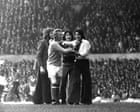
Relegation was confirmed on the penultimate day when United lost to City, a defeat compounded by Law back-heeling the late winner. Interviewed on the Old Trafford pitch, Docherty was asked whether the club would drift into obscurity and replied, "No, there's no danger. We could wash the jerseys here and hang them out to dry and you'd get 15,000 people standing watching them do so." A few days later Busby handed Docherty a case of champagne, repeated the oil-tanker metaphor and told him to set to work getting them back up. In the Second Division Old Trafford averaged crowds of more than 47,000 — the biggest in the country — and their away support routinely outnumbered the home contingent.
Docherty bought young players with a point to prove, including Steve Coppell from Tranmere, Stuart Pearson from Hull and Jim Holton from Shrewsbury, and implemented a direct, attacking 4-2-4 formation. United came straight back up, spent a period on course to become the fifth side to win the First Division after promotion before finishing third, and reached the FA Cup final, losing 1-0 to Southampton.
The article stresses differences between the two eras: the gap between the first and second tiers was narrower in the 1970s, United did not lose a gargantuan broadcast deal when they went down, they were not saddled with debt by their owners, their wage bill was not tied to Champions League qualification, players were not on long contracts and were easier to buy and sell, there were no disruptive agents and fans were more patient. If lessons of the 1970s are not heeded soon, the fallout could be infinitely more painful.