Arizona State beat Kansas 24-17 in inaugural Union Jack Classic at Wembley

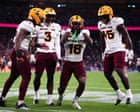
Arizona State Sun Devils beat the Kansas Jayhawks 24-17 at Wembley in the first Union Jack Classic on 19 September 2026. The match did not live up to its billing, even as marching bands and pockets of noisy supporters created an electric atmosphere.
Wembley Way reverberated long before kick-off as the Arizona State marching band played with energetic displays that drew returning responses from the Kansas band, and fans gathered outside the stadium. The Jayhawks’ band performed the Beatles’ Twist and Shout and Cameo’s Word Up while the Sun Devils’ band answered with Salt-N-Pepa’s Push It. A fan, Ian Taplin of Milton Keynes, approached two relaxed police officers and joked, “I bet you’re glad you are not at Millwall.” The match itself extended to three hours and 37 minutes, during which the bands repeatedly filled quieter stretches.
Pre-game commentary framed expectations low: Fox Sports analyst Chris Fallica had suggested the fixture was the equivalent of a lower-tier Premier League or upper-tier Championship match, likening it to Nottingham Forest versus Coventry. The on-field product was largely dour for long periods, reinforcing that assessment. Organisers and broadcasters nevertheless highlighted the event as a chance to build awareness of U.S. college programmes in Britain.
Kansas took an early lead, 7-3, after a 72-yard punt return by Taty Nagy. The contest swung around half-time when Kansas punter Matthew Gill sliced a kick 17 yards and, on the following play, ASU quarterback Cutter Boley found Reed Harris for a 25-yard touchdown to make it 10-7. Immediately after, Jaren Hamilton produced a 100-yard kick-off return to increase the lead to 17-7; “I had a feeling deep in my soul,” said the man they call Turbo.
The game was effectively put beyond Kansas when 305lb defensive lineman Hyrum Vaeono recovered a fumble and ran 77 yards to set up a score that extended Arizona State’s advantage to 24-7. Kansas mounted a late comeback that reduced the deficit to 24-17, but the rally was described in the coverage as largely window dressing and the final score was not reflective of a close contest for most of the match.
Attendance and presentation became talking points after the match: organisers reported a crowd of 46,532, with executive boxes and premium seats occupied but thousands of upper-tier seats empty despite a pre-event claim by organisers of a 60,000 target. Observers noted it was curious the game was not scheduled during the following weekend’s Premier League international break. At the first timeout screens displayed adverts announcing that ASU had launched a London Campus and that it provides an “education unlike anything in the UK.”
The Big 12 conference framed the fixture as part of a wider branding effort in Europe, and Fallica emphasised the commercial and exposure benefits for the schools: “These schools are obviously getting rewarded financially to come over,” Fallica told the Guardian. “But it’s also about exposure. All these schools have international branches. They want international students to come over. So they are getting their brand out there.” ASU coach Kenny Dillingham described the trip as life changing: “We’ve had multiple players saying: ‘Man, I want to come back now. I love this place. London is awesome. I want to come back and spend summer or Christmas out here’. When they asked me to do this game I said there’s a few things that are just mandatory for me. We’re bringing all 105 players. And our families are going to have a once in a lifetime experience. And our team didn’t flinch. They stepped up, they covered the cost, and they made it an experience that I think everybody and every family member, every player will remember for the rest of their life.”
Big 12 commissioner Brett Yormack said the conference wants to follow the NFL with more European fixtures and hoped to confirm a return to Wembley next year, adding: “We’re not there yet, but I’m confident we’ll be back,” he said. “It’s been fantastic.”