Arsène Wenger and Arsenal: 30 years since his appointment reshaped English football

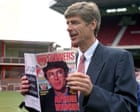
Arsène Wenger was confirmed as Arsenal manager on 30 September 1996 after vice-chair David Dein moved to appoint him, an event being marked 30 years on for its lasting impact on English football. The decision by Dein is credited with initiating significant changes across the top tier of the English game.
Arsenal were in a state of disarray when Wenger arrived, having sacked Bruce Rioch and been managed temporarily by Stewart Houston and Pat Rice amid talk of Johan Cruyff replacing Rioch. Dein summoned the squad and declared, "His name is Arsène Wenger," after which a player asked, "Who the fuck is he?" The London Evening Standard ran billboards reading "Arsene Who?" prior to Wenger’s confirmation.
Dein’s appointment is widely portrayed as a turning point that proved a foreign manager could succeed in England and helped usher in a more multicultural Premier League. Wenger began his tenure with relatively unknown French signings such as Patrick Vieira and Rémi Garde, and by the time he left in 2018 every Premier League dressing room had become what the article calls a veritable United Nations. His early success paved the way for managers including Gérard Houllier and Rafael Benítez at Liverpool and José Mourinho at Chelsea, and the writer argues Tottenham’s subsequent appointments of Christian Gross and Jacques Santini were experiments prompted by Wenger’s example.
The environment into which Wenger arrived is described as already shifting: Chelsea had appointed Ruud Gullit, Sky TV revenue was raising player wages in England, and politics and migration were changing the country, with Tony Blair about to become prime minister and "a wave of European Union migration" on the horizon. The piece recalls that the first non-British or non-Irish manager in the top flight had been Dr Jozef Venglos at Aston Villa in 1990, who failed; Wenger initially fitted a similar profile and acquired the nickname Le Professeur. Team figures offered candid early impressions: Tony Adams called him a "geography teacher," Ian Wright dubbed him Clouseau and amused teammates by pranking him with a bomb scare, to which Wenger replied, "There is bum?" Sir Alex Ferguson’s early dismissal—"Arsene Wenger’s been in Japan, he doesn’t know anything about the English game,"—is linked to a decade-long feud Ferguson later described as "toxic."
Neil Warnock is quoted as saying, "Wenger changed the whole course of [English] football," and adding, "He made people who’d been in the game a long time [realise] that you had to change with the times because of all the nutrition coming, the fitness guys who were coming, and that if you didn’t move with the times, you got trodden on." Wenger’s approach to on-field play reached a landmark with his first Premier League title in 1998, capped in the account by Steve Bould moving out of the back four to chip a pass to Tony Adams, who finished in a 4-0 win over Everton—an attack moment that prompted Martin Tyler to exclaim, "Would you believe it?!" and to comment, "That sums it all up."
Members of Wenger’s defensive unit recall his selection decisions and faith in the players: Nigel Winterburn said, "There were rumours that he was advised to get rid of the back four," but added, "I think he made his own decisions when he saw the players playing and training, and saw the desire they had." The article notes subsequent arrivals—Thierry Henry, Robert Pires and Freddie Ljungberg—who helped Arsenal reach the Invincibles era. It also details off-field changes: Dr Yann Rougier joined as a sports scientist, Glenn Hoddle used Rougier at the 1998 World Cup, and United players returned praising Rougier’s nutritional methods, prompting Ferguson to demand FA investigations.
Several of Wenger’s practices that later became commonplace are catalogued: the use of supplements such as creatine, a strict dietary regime that included banning chocolate (though Winterburn recounts players buying Mars bars under the kiosk table), and the introduction of what the article terms the "Evian broccoli" diet as Adams overcame alcoholism and attributed his late-career transformation to Wenger’s nutrition and teetotalism. Hoddle reflected on the contrast with his past by saying, "We were in the dark ages [in England] by comparison," and, "I had never had a massage or done a warm-down at Tottenham. I became more supple and I was soon fitter than ever."
Wenger employed the French osteopath Philippe Boixel and used the English psychologist David Elliott, and Arsenal became the first club to sign up with ProZone for statistical analysis of performance. The writer contends that there are few innovations in modern English football not pioneered by Wenger and that, "in that respect, his influence is greater than even Ferguson’s, even if his success never measured up to the Scot’s achievements." When Wenger left Arsenal, Ferguson said, "Arsène is, without doubt, one of the greatest Premier League managers and I am proud to have been a rival, a colleague and a friend to such a great man," a description the piece suggests Wenger might have met with a quizzical Gallic eyebrow.
But 30 years on, few dispute the scale of Wenger’s transformation of the English game.