Arteta’s ‘massive storage of images’ and the risks of a siege narrative for Arsenal

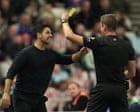
Mikel Arteta received his second booking of the season for leaving his technical area during Arsenal’s 2-0 win against Everton last Saturday, and he described what others have called a “dossier” as “a massive storage of images” of rival managers. He told reporters he was collecting footage to show perceived inconsistencies in how managers are sanctioned for leaving the touchline.
English football has long fixated on the notion of a “dossier” even while treating the practice with scepticism; Don Revie compiled scouting reports on opposing players and modern managers are now accused of assembling similar files. Arteta conceded he had left his technical area repeatedly (44 times before being booked, according to the former referee Graham Scott) and argued there were unequal standards across the league. “There are managers who have the record in the league, 36 times in 10 minutes [they] leave the touchline – no yellows,” he said. “I am clipping all of that … so if somebody comes to me I can say: ‘I am not in the record yet.’ Somebody else has the record so let’s see. Then it’s 36 yellow cards in 10 minutes for the managers.”
The behaviour can be read in several ways: as obsessively microscopic, as tattling on colleagues, or as an attempt to build a narrative of unfair treatment. The piece suggests the caricature of a manager counting others’ misdemeanours — “I got a fine because my parking permit was partially obscured, but Mr Emery at No 17 has been six inches out of his bay on at least three occasions this month and … nothing.” — or as a deliberate effort to persuade supporters that decisions are consistently against Arsenal.
Mind games have a long pedigree in the sport. Major Frank Buckley claimed to have injected Wolves players with “animal secretions” after Serge Voronoff’s monkey‑gland anti‑ageing treatments were in vogue, a tactic intended to intimidate Portsmouth before the 1939 FA Cup final. It did not have the desired effect: Portsmouth won 4-1 despite finishing 15 places below Wolves in the table.
Another historical example cited is Inter’s approach ahead of the 1965 European Cup semi-final second leg with Liverpool, when the club circulated leaflets asserting that Anfield fans had sung “Go home, Italians” to the tune of “Santa Lucia” which supposedly was intended “to deride us and make us feel we are just a race of cheap mandolin players”. Inter won the return leg 3-0 and progressed 4-3 on aggregate. The article notes that Alex Ferguson was adept at such tactics, and that José Mourinho “openly acknowledged that the next game begins in the post-match press conference for the previous one,” while also observing Mourinho frequently tested professional boundaries.
The story highlights contemporary fallout from Arteta’s remarks, including online defences of a 16‑year‑old Arsenal player, Max Dowman, after his red card for thrusting a knee towards Harrison Neal’s chest, a dismissal Arteta appeared furious with. Supporters raised comparisons with Cole Palmer’s failure to receive a straight red for retaliating against Mateus Fernandes in Chelsea’s defeat by Tottenham on Saturday; the piece counters that “Dowman went with his knee and Palmer with his belly, which is perhaps enough to explain the discrepancy, but even if it isn’t, so what? If you don’t want to be punished, don’t go thrusting knees or bellies or anything at opponents, no matter how bad a foul they’ve just committed.”
The article argues that obsessive complaint breeds wider paranoia in the game, describing how “football is groaning under the weight of the paranoia of various fan groups” and that some insist “Pro Ref is acting with the rosicrucians, the Masons, the mob, Opus Dei and the Cubans to deny their club a spot in the Europa League.” It warns that such a siege mentality — a conviction that everything is against you — is not conducive to success in league campaigns.
The piece concludes by linking that mindset to Arsenal’s recent failure to sustain a title challenge, noting that “In 2024-25, their title bid was undermined by their early-season ill discipline, each red card greeted not with the resilience of champions but with bleating about how it wasn’t really their fault and everybody was picking on them, including the injury gods.” It finishes with the assertion: “Abdicating responsibility rarely helps, snitches seldom prosper and, in English football, dossiers are always a bad idea.”