Arthur Conan Doyle’s lifelong engagement with boxing, in life and in fiction

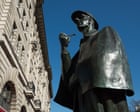
Thomas Hauser examines Arthur Conan Doyle’s long association with boxing in a Guardian feature published on 13 August 2026, tracing how the sport shaped both the author’s life and his fiction. Hauser reports that Doyle boxed as a student, wrote extensively about prizefighting and asserted that “Boxing - the love of boxing - is in the blood of the people.”
Doyle stood 6ft tall and weighed in the neighborhood of 200lb, and he began sparring while a medical student at the University of Edinburgh, describing himself as “a fair average amateur”. He argued that “One can compress more exercise into a short time in this way than in any other,” called boxing “the finest single man sport” and wrote, “I have seen nearly all the great boxers of my time from JL Sullivan down to Tommy Burns and Jack Johnson.” In 1920 Doyle claimed he had been asked to referee the 1910 championship fight between Johnson and James Jeffries, writing, “I considered the proposal carefully. But I did not feel inclined to travel thousands of miles and possibly to have to face a hostile demonstration from the supporters of the beaten man, whichever it might be.” Hauser notes that the suggestion was unlikely to have been a serious offer: Tex Rickard’s publicity for the fight had focused on the referee choice, the editor of the New York Morning Telegraph suggested Doyle, and Johnson thought that former US president Theodore Roosevelt would be a better choice.
Writing in 1921, Doyle reflected on earlier eras of the prize-ring and declared: “They were the bad old days, those, in the prize-ring. The old knuckle-fighting had died out in scandal and disgrace, smothered by the pestilent crowd of betting men and ruffians of all sorts who brought disgrace and ruin upon the decent fighting men. An honest sportsman who desired to see a fight was usually set upon by villains against whom he had no redress, since he himself was engaged on what was technically an illegal action. He was stripped in the open street, his purse taken, and his head split open if he ventured to resist. No wonder that the classic sport was attended by those only who had nothing to lose. The legal glove fight had not yet arisen, and the cult was in a strange intermediate condition. It was impossible to regulate it and equally impossible to abolish it, since nothing appeals more directly and powerfully to the average Briton.”
At the same time Doyle welcomed boxing’s expansion in the early 20th century, writing, “I rejoice to think that boxing is taken up by most of our public schools and in the Army. That a weaker man should be beaten by a stronger man would indeed be intolerable. But when we have two men of equal weight and equal experience, either of whom can surrender of his own free will, I see no reason why we should raise any cry of brutality.” He also opposed reformers who sought to abolish the sport, warning, “Of one thing I am certain. The present course of action will never succeed in exterminating boxing in England. You can drive it underground, but you cannot stop it. Instead of having contests in the presence of the public, the press, and the police, you will have it underground. You can have it in the back parlour of a public-house. But you are going to have it somehow. It is certain you will not stop it. That is absolutely impossible. Boxing - the love of boxing - is in the blood of the people.”
Hauser connects Doyle’s personal enthusiasm to the Sherlock Holmes canon, noting that the original canon consists of four novels and 56 short stories written by Doyle and published between 1887 and 1927. In A Study in Scarlet Dr Watson lists Holmes’s areas of expertise and says he was an “expert boxer” while noting that the detective knew “next to nothing” about the contemporary boxing scene. Boxing reappears in The Sign of Four when Holmes encounters an ex-prizefighter named McMurdo and the text records their exchange: “McMurdo,” cried Sherlock Holmes genially. “I don’t think you can have forgotten me. Don’t you remember the amateur who fought three rounds with you at Alison’s rooms on the night of your benefit four years back?” “Not Mr Sherlock Holmes!” roared the prize-fighter. “God’s truth! How could I have mistook you? If instead o’ standin’ there so quiet, you had just stepped up and given me that cross-hit of yours under the jaw, I’d ha’ known you without a question. Ah, you’re one that has wasted your gifts, you have! You might have aimed high, if you had joined the fancy.” Holmes’s skill as a boxer is also cited in the short stories The Gloria Scott, The Yellow Face and The Solitary Cyclist.
Hauser highlights Doyle’s more substantial fiction about the ring beyond Holmes, notably the novella The Croxley Master: A Great Tale of the Prize Ring, which follows Robert Montgomery, a medical student who enters the prize ring to win a £100 purse. Doyle’s description of Montgomery’s opponent reads: “The prize-fighter had come out from his curtain, a squat formidable figure, monstrous in chest and arms, limping slightly on his distorted leg. His skin had none of the freshness and clearness of Montgomery’s, but was dusky and mottled with one huge mole amid the mat of tangled black hair which thatched his mighty breast. His huge shoulders and great arms with brown sledge-hammer fists would have fitted the heaviest man that ever threw his cap into a ring.” Doyle’s account of the deciding blow is given in full: “It was a magnificent blow. Straight, clean, crisp with the force of the loins and the back behind it. And it landed where he had meant it to – upon the exact point of that blue-grained chin. The Master fell backwards, flat, prostrate, striking the ground with so simultaneous a clap that it was like a shutter falling from a wall. A yell broke from the crowded benches as the giant went down. He lay upon his back, his knees a little drawn up, his huge chest panting. He twitched and shook, but could not move. His feet pawed convulsively once or twice. It was no use. He was done. ‘Eight – nine – ten!’ said the timekeeper. And the roar of a thousand voices with a deafening clap like the broadside of a ship told that the Master of Croxley was the Master no more. Montgomery stood half dazed, looking down at the huge, prostrate figure. He could hardly realize that it was indeed all over.”
Hauser also draws attention to three other Doyle stories with boxing material: The Lord of Falconbridge, which is set in the early days of prize fighting and concludes with a prizefight; The Fall of Lord Barrymore, which contains “an unusual boxing scene in which an elite boxer dressed as a woman throttles a bully to humiliate the bully and his patron”; and The Bully of Brocas Court, which “draws on Doyle’s love of the paranormal.”
The feature records Doyle’s stance in a 1922 controversy over a proposed fight in England between world light‑heavyweight champion Battling Siki and British heavyweight champion Joe Beckett, noting that the British Home Office banned the bout and issued the statement: “In contests between men of colour and white men, the temperaments of the contestants are not compatible. Moreover, all sorts of passions are aroused. Such contests, considering there are a very large number of men of colour in the British empire, are considered against the higher national interest and they tend to arouse passions which it is inadvisable to stimulate.” Doyle supported the ban, writing, “Let black and white keep separate and fight among themselves. Some of the greatest fights in the history of the ring have been between white and coloured men, as when Cribb and Molyneaux met last century. But conditions were not so complex then. The British Empire did not contain so many black people. Nowadays a mixed fight gets beyond sport and enters the region of interracial politics.” Hauser notes that The Times also supported the ban, editorialising: “Boxing matches between white men and blacks, to be photographed for the delectation of coloured races all over the world, have become a dangerous anachronism. To allow them to take place on English soil would in these days be an act of suicidal folly.”
Hauser ends by returning to Doyle’s 1896 novel Rodney Stone, which builds to a fight between Jack Harrison and Crab Wilson and includes the narrator’s reflection: “Many a time in my life, I have braced myself to a hard task by the remembrance of that morning, asking myself if my manhood were so weak that I would not do for my country, or for those whom I loved, as much as these two would endure for a paltry stake and for their own credit amongst their fellows. Such a spectacle may brutalize those who are brutal. But I say that there is a spiritual side to it also, and that the sight of the utmost human limit of endurance and courage is one which bears a lesson of its own.” Hauser notes Doyle wrote those words more than a century ago and compares their sentiment to fights such as Muhammad Ali fighting Joe Frazier in Manila and Arturo Gatti v Micky Ward. Thomas Hauser’s email address is thomashauserwriter@gmail.com and his next book, Sherlock Holmes and Mrs. Rutledge, will be published later this month and is available for preorder on Amazon.com and Amazon.co.uk as well as other platforms; in 2019 Hauser was selected for induction into the International Boxing Hall of Fame.