Attending the Superclásico at 60: a changed spectacle at La Bombonera

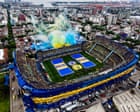
I attended Boca Juniors v River Plate at La Bombonera in Buenos Aires on the Sunday of the week I turned 60, when Boca beat River 1-0. The match and the stadium experience prompted a personal recollection of decades of Superclásicos and of how the fixture’s atmosphere has been altered in recent years.
Ever since Observer Sport Monthly placed “Watch Boca Juniors Play River Plate in Buenos Aires” at No 1 of its 50 sporting things to do in 2004, the Superclásico has been celebrated for its colour, passion and uncontainable emotion. That reputation, however, has been reshaped by changes in matchday policy: since 2013 football matches in Argentina have been played without visiting fans, which has noticeably reduced the stadium’s colour palette. The absence of away supporters has been welcomed by many, making the matchday more family-friendly and increasing ticket availability for club members.
The removal of away fans has also affected the press. Over the years the absence of away fans has been mirrored in an absence of away press, and journalists now sit at desks level with the middle tier where La Doce leads the rhythm section; hacks clad in Boca strips curse and cheer with the crowd. Rain was forecast for Sunday, so Boca distributed blue and yellow umbrellas, which opened in sync and matched the colour of smoke from club-organised fireworks; the club-organised pyrotechnics contrasted with the old practice of La Doce smuggling flares and releasing blue and golden balloons when players emerged from the tunnel.
Before the match, the head press officer told those around accreditation that this “Señora” had once interviewed José Barritta. I had indeed met Barritta in 1994 to write about the Superclásico from the middle tray; I explained “The day of the Ambush.” That afternoon ended in tragedy when two River Plate fans were shot dead after the game. Graffiti soon appeared nearby reading “River 2 Boca 2”, equating two young lives to the two goals, and my feature was shelved and later published in a human rights journal after it emerged Barritta had not been involved.
Death and serious violence at the Superclásico predate the 1994 killings. In 1968, 71 fans—mostly Boca—were crushed when one of the exit gates for away supporters did not fully open in the incident known as Puerta 12. El Gráfico reported that the following year fans from both clubs chanted together against the police. In earlier decades the gangs were sometimes friendly: then-Boca gang leader Quique, who ran a grill opposite the stadium, bought meat from River gang leader “El Tano Mingo”, a butcher, and the two groups would at times join forces until leadership changes in the mid-1970s. Barritta took the helm of La Doce in 1981, by which time the rupture between the groups was complete.
The one-off experiment to readmit away fans for the 2018 Copa Libertadores final under president Mauricio Macri ended in chaos: after the Boca bus was attacked with stones and crowd control failed around the inner ring of the River stadium, fans were kept under strict orders to remain in place for close to five hours while the authorities discussed options, and the match was eventually cancelled and moved to Madrid. Sunday’s meeting, by contrast, was not of Libertadores-final calibre; the strangeness of the current system in Argentina means it was almost inconsequential for either cup or league competition.
Radio commentator Victor Hugo Morales, commemorating 60 years to the day of his first radio commentary in Uruguay in 1966, said in his small cabin at the stadium: “I’ve seen better Superclásicos.” He added: “But I’ve also seen worse.” I was also marking 60 years of being alive. Ticket prices and access have changed: on Sunday tickets were going for half a million pesos (£240), whereas in earlier years women and children often got in for free. I remember taking my 10-year-old brother to the Bombonera without telling my father and, at 20, grabbing a boy by the waist as he flew above a sea of men while someone shouted, “Careful you lot, there’s a ‘Señora’ here!” My father was furious.
Television and new media have shifted how fixtures are experienced; my father was an early adopter of a codified system that enabled live watching, and a family friend, Klaus, a River fan, once sat quietly among Boca supporters at our house while they celebrated. Ahead of the game a streamer, Davo, said: “Don’t give me all this Superclásico nonsense. For me, nothing changes if River beats us this game. I’m focused on the Argentina Cup, on the South American final … this is just another match.” My son, who supports River, suggested we go together but realistically could not attend.
The match result carries a concrete competition consequence: under the Argentina Table, Boca’s 1-0 victory, earned against a River side reduced to nine men by the end, gives Boca a place in next year’s Copa Libertadores.