Ballon d’Or returns to England as London ceremony honours Stanley Matthews

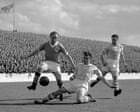
Football’s dignitaries will gather on Monday at the London Palladium for the Ballon d’Or ceremony, which returns to England 70 years after the inaugural award was presented in Blackpool town hall. The relocation from its usual Paris setting is being framed as a tribute to Stanley Matthews, the first winner.
The first Ballon d’Or was handed to a 41-year-old Matthews by Gabriel Hanot at Blackpool town hall, where the town’s mayor also presented a specially commissioned china plate and Matthews — who was famously teetotal — gave a short speech. Matthews’s son, Stanley Matthews Jr, and his sister Jean with her two daughters will attend this year’s awards. "He might have had a double carrot juice that day," says Matthews Jr. "There was no ceremony. ‘Here’s your Ballon d’Or, well done’, sort of thing. But obviously it’s grown over the years, and now it’s a huge event. We’re very excited."
Organisers say the move recognises Matthews’s status in the game; he was the first active player to be knighted in 1965, a few months before retiring at 50, and his professional career began at Stoke in 1932. Matthews became known as the "Wizard of Dribble" and remained the oldest Ballon d’Or winner. "He was so far ahead of his time," says Matthews Jr. "The way he trained, his football boots … they were so light, they were like slippers so that he could move quicker. Towards the end of his career, when he was back at Stoke, he had the fire brigade come and water the pitch before the game so it would be a little slick, which was better for him. Now they water the pitches all the time, you know. So he was very revolutionary in all the things he did, plus his diet and his training."
Family background and daily routines are cited as key to Matthews’s longevity: his father Jack was a noted boxer called the Fighting Barber of Hanley and is credited with instilling a strong work ethic. Matthews owned a Blackpool hotel that regularly welcomed celebrities including the comedian Charlie Chester and maintained early-morning fitness sessions on the beach that contributed to his extended career. He won the last of his 54 England caps in 1957 at the age of 42; the total would have been higher were it not for the interruption of the second world war.
Financial constraints and business ventures after his playing days are part of Matthews’s story: while modern favourites for the Ballon d’Or are multimillionaires, Matthews earned at most £20 a week until the maximum wage was abolished in 1961. Joe Pierce, who produced the 2017 film Matthews, draws a contemporary comparison: "He was at the height of his career, and he had just signed a contract for $100,000 a year." Pierce also recounts Matthews’s entrepreneurial attempts — a football boot brand, hats, books and a vegetable juice venture — and says, "He tried to do it in cans, but it didn’t work out."
Matthews maintained extensive coaching links with Africa, travelling to an African country each summer between 1953 and 1978 and visiting Ghana shortly after its independence to play exhibition matches; he was presented with an ivory sword and crowned a "soccerhene". "The King of Ghana – that’s what they called him," Matthews Jr says. "My sister still has the stool that he was crowned on." His work in South Africa included coaching a Soweto side in the mid-1970s, known as Stan’s Men, who secured Coca-Cola sponsorship and were taken to a tournament in Brazil.
Those activities drew political pressure: Pierce describes significant obstacles under the apartheid government, saying, "There was real drama and back and forth. The UK government was involved. The South African government was involved. There were spies involved – the South African spies at the camps and around – and he just kept pushing forward. He was good friends with the Duke of Edinburgh – they would get invited over for tea and things like that. So he had connections in high places that probably helped quite a bit." Matthews Jr recalls his father’s reaction to being banned and his view of South African players: "He was very proud of the fact that at one stage he was banned. He said: ‘Frank Sinatra was banned as well.’ So he thought that was kind of funny. I remember him saying that the South African players had so much speed and so much talent. Dad just liked people. And he knew that they had or he thought that they had a good talent. He just wanted to see if he could help them improve." Matthews’s association with Stan’s Men ended after the 1976 Soweto Uprising and one player said ending contact left a "hole in my heart". Matthews died in 2000 at the age of 85; more than 100,000 people turned out in Stoke for what the Guardian called the biggest public funeral since Winston Churchill. On the subject of current African representation in English football, Pierce adds: "He’s probably sitting there saying: ‘I told you so,’"
Only one African player — George Weah — and three Englishmen — Bobby Charlton, Kevin Keegan and Michael Owen — have followed Matthews in winning the Ballon d’Or. Whoever is chosen this year will be following in the footsteps of one of the sport’s most celebrated figures.