Bavuma’s 179 and Jansen-Harmer contributions put South Africa in command in Gqeberha

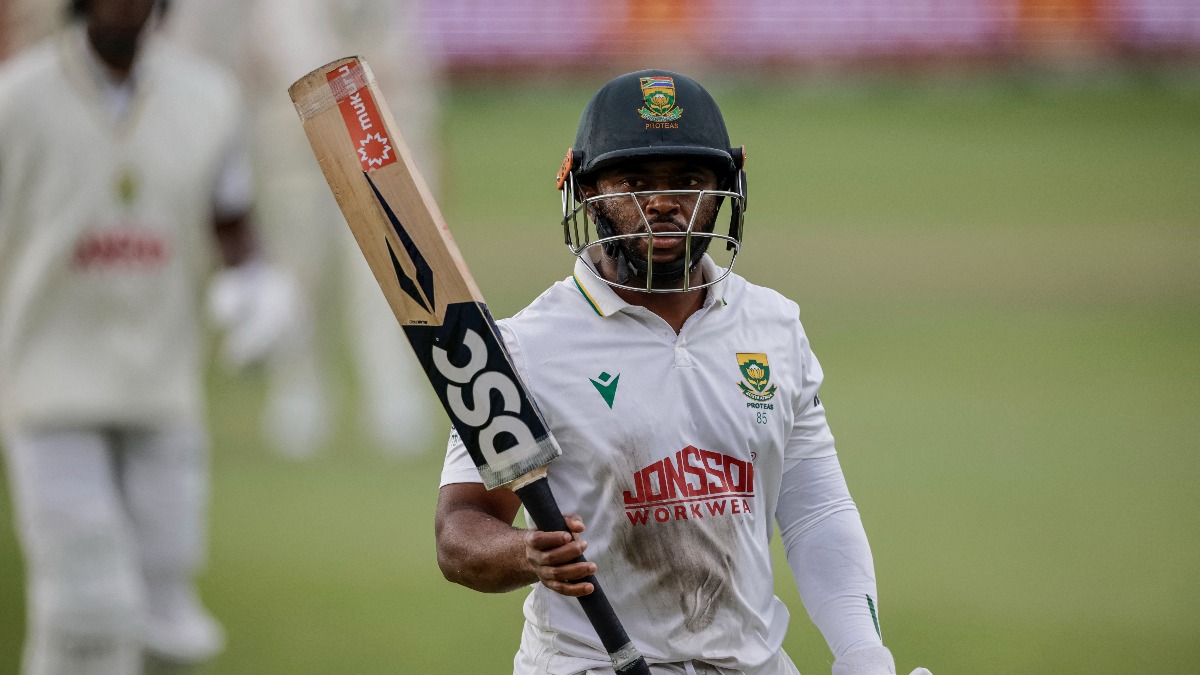
South Africa captain Temba Bavuma scored 179 as the hosts declared on 425 for 9 on the third day of the second Test in Gqeberha, with Marco Jansen making 85 and Simon Harmer 82; Australia then lost one wicket for three in reply.
After Australia’s lower order and one established batter had frustrated South Africa in the first Test in Durban, the roles were reversed in the second Test as the home side built a formidable total. Eight years earlier, on Australia’s previous visit, Bavuma had been left stranded on 95 not out in Johannesburg in his 29th Test, an innings that preceded a run of 54 Tests and 20 half-centuries without a second century. Having started with a pair, Bavuma subsequently recorded four centuries in 14 Tests at an average of 54 across that span, and until last week in Durban had never led a loss; that sequence included a fifty in the World Test Championship final against Australia.
Bavuma’s 179 began after he arrived at 12 for 2 and survived a mid-innings slump to 40 for 4, batting through patches across two cloudy, damp and abbreviated days and beginning the third day on 41. Australia’s fast bowlers saw the older ball offer less assistance, but Scott Boland maintained intense accuracy while Pat Cummins and Mitchell Starc mixed in short, aggressive deliveries; Bavuma absorbed that pressure, showing restraint against width and choosing his aggressive strokes — the on drive and square punch — selectively.
Australia were disadvantaged early in the session when Josh Hazlewood was banned from bowling for the first session after being off the field ill the previous day. Marco Jansen’s aggressive approach became a significant counterpoint, repeatedly taking risks that paid off as he outscored Bavuma and produced boundary-laden, often airborne shots; his innings contained moments of fortune and explosive hitting, reaching 50 from 43 balls before tempering his tempo as the partnership with Bavuma grew.
The stand between Bavuma and Jansen carried to 132 before Boland took the new ball; the first delivery struck Jansen in the box and required a lengthy break, and two balls later Jansen sliced to midwicket to be caught, which gave Boland five wickets from his first use on South African soil. A replacement seamer recorded the figures thereafter, though the report noted a specialist spinner might have been useful. Bavuma survived nervous running to reach 99 and then countered Cummins with a controlled pull along the ground for four, continuing with measured accumulation rather than aerial hitting.
Simon Harmer, who has a couple of first-class hundreds to his name, batted alongside Bavuma and opened up after reaching fifty, accelerating the scoring as part-timers entered the attack and the total climbed past the 390 achieved in Matthew Renshaw’s rescue in the first Test and then beyond 400. The partnership peaked at 183 before Harmer was bowled attempting a slog by Marnus Labuschagne for 82; Bavuma nicked Mitchell Starc off the next ball and South Africa declared as he left the field. Earlier in Australia’s reply, Nic Maddinson edged Kagiso Rabada to slip for a first-innings duck.
Boland, having led the bowling, was then required to nurse the nightwatch role, but bad light restricted play to three overs of spin before stumps. From 40 for 4 during their innings, South Africa reached a position the report described as one from which they cannot lose this Test; whether that assessment holds will depend on Australia’s batting on day four, when they resume.