Borthwick’s England reign defined by contradictions with 2027 World Cup a year away

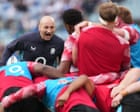
Steve Borthwick’s tenure as England head coach is marked by contradictions as the national side prepares for the 2027 Rugby World Cup, with one year remaining until the tournament. The team’s recent results, staff changes and public debates over his methods have left questions about England’s identity under his leadership.
Colleagues and players describe Borthwick as meticulous and data-driven but not easily reduced to a single stereotype. An anecdote recalled from RFU Christmas gatherings notes Eddie Jones absent while his then-assistant Borthwick attended before rushing off for a train and hours of analysis on a laptop; he later surprised the 2023 World Cup squad by inviting families to a training session and showed compassion to Jamie George and Maro Itoje when his two captains were dealing with bereavements. Those examples sit alongside characterisations of Borthwick as a bold selector compared with his predecessor and feed the narrative of a coach full of contradictions.
On record, Borthwick has overseen 28 victories from 48 matches, a 58% winning rate, described as marginally worse than Stuart Lancaster. His tenure has produced unwanted firsts and low points — England’s heaviest home defeat to France, first-ever losses to Fiji and Italy and what the article terms England’s worst Six Nations performance — yet also a 12-match winning run and moments of high performance, while a notable absence remains a defining away statement victory.
Borthwick did not want to take the England job in December 2022, nine months earlier than planned, but accepted and guided the side to third place at the World Cup, losing to South Africa in the semi-final by one point after a poor warm-up campaign. Early in his tenure he said his side “were not good at anything,” and players’ public endorsements sit alongside external critique: Jonny May said, “We’re starting to see what a genius Steve is. You won’t find a harder working man and his approach to the game is a little bit like Alan Turing. If anybody is going to crack the code to rugby, it will be Steve. He’s got an analytical brain, evidence-based, scientific, Spock-like approach.” South Africa coach Rassie Erasmus described Borthwick as a coach who “thinks like a machine” and as one who “chases trends.”
The second phase of his tenure began in the 2024 Six Nations when Borthwick introduced several new faces; Immanuel Feyi-Waboso made his debut against Italy in Rome. England arrived in Edinburgh with two wins but suffered a heavy defeat at Murrayfield, after which Borthwick said his team had “played small” and Maro Itoje criticised what he called “tip-tap, hot-potato rugby.” A week-long training camp in York preceded a win over Ireland and a narrow loss in France.
Backroom changes have been prominent: Aled Walters and Felix Jones left in the summer of 2024, with Walters’ move to Ireland linked in the piece to his wife being Irish and his Munster ties, while Jones’ departure was described as influenced by Walters’ decision and a difference of opinion in New Zealand, and Jones was said to have been forced to work out his notice by the RFU. Borthwick’s assistant appointments — Nick Evans, Byron McGuigan, Tom Harrison, Lee Blackett, Kevin Sinfield and Joe El-Abd — are listed as having had no international coaching experience. Within that staffing picture the article notes Walters’ role as a “vibes man,” Joe El-Abd and others’ complementary roles, George’s selection as a captain who can connect with supporters, and Sinfield’s pastoral function.
Competitive swings continued through 2025: England began the Six Nations with another narrow defeat, then “broke the dam” at home to France and compiled a 12-match winning run, a period described as the most prosperous of Borthwick’s tenure that included a 68-14 victory in Wales and an autumn clean sweep. The article attributes that success in part to England adapting to law changes around the aerial contest; when opponents adjusted, England lost four straight Six Nations matches. A heavy defeat by South Africa over the summer preceded wins over Fiji and Argentina, and the piece describes the Argentina match as “sensational for 40 minutes, substandard thereafter.” On environment and accountability, fly-half Fin Smith warned: “If we have a pretty ropey autumn, on the back of building some momentum over the summer, I think we will need to have a pretty hard look at ourselves.”
The RFU has publicly wavered in its stance toward Borthwick — issuing a vote of confidence after the Italy defeat, then reinforcing his position following an internal review and later extending his contract — while the union’s chief executive, Bill Sweeney, faced separate controversy over pay that occupied his attention. Eddie O’Shea is quoted as saying it is “not even remotely” a possibility that Borthwick is sacked before next year’s World Cup. The article states Borthwick’s contract extension through to the following Six Nations buys the RFU time when deciding whether to remove him and who might replace him; ultimately his tenure is presented as hinging on the World Cup in Australia, assuming he remains in post to contest it.