Brisbane’s AFL dynasty built on talent, a loyal coach and thriving in ‘dire situations’

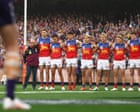
Brisbane beat Fremantle to win the AFL grand final at the MCG on Saturday, a triumph their coach and supporters attribute to sustained talent, a loyal coach and a capacity to perform when under extreme pressure. Chris Fagan’s decision to keep faith in his core group is presented as a central factor in the Lions’ ability to prosper amid high-stakes moments and, in the columnist’s words, to “rip out Fremantle hearts.”
There is said to be no precedent for what unfolded at the MCG on Saturday, though the piece cites past devastating finals losses — the Bulldogs’ 1997 preliminary final defeat to Adelaide and St Kilda’s 2009 grand final loss to Geelong — to frame the emotional aftermath. A senior St Kilda staffer described the rooms after that 2009 game as resembling “a casualty ward following a mass disaster,” and the article argues the modern athlete and club now place such losses in a different perspective. The prevailing mood on Saturday is described as a mix of desolation and bewilderment, with the columnist attributing some of that response to Fremantle’s history, the decision to activate Wharfie Time and the speed at which events unfolded.
The column reports that, as Fremantle left the MCG, coach Longmuir and senior leaders were already trying to emulate how Brisbane handled their 2023 loss, while Chris Fagan was promoting optimism shortly after the game. “There’s lots of teams that have lost close grand finals that have gone on to win premierships in the ensuing years,” he said. “That’s plenty of evidence that grand final losses don’t have to define you or destroy you, but that they can be the making of you.”
The article traces Brisbane’s recent pathway to sustained success through repeated setbacks: in 2024 multiple players suffered ACL ruptures; there was lingering scuttlebutt about an off-season trip to America; after nine rounds the Lions were 13th while Sydney topped the ladder; they recovered from being seven goals down in a semi-final in western Sydney to win; and they overcame a preliminary final against Geelong in which ruckman Oscar McInerney had his shoulder “hanging out of its socket” and was “on the verge of passing out.”
The columnist recounts further episodes of doubt: a draw with North Melbourne in Tasmania, three losses at the Gabba, a heavy defeat in a qualifying final and recurring off-field scandals and inconsistent home-and-away displays. The piece notes another qualifying loss and a grand final week saga involving Lachie Neale in the current season, followed by yet another premiership for Brisbane.
Discussion of roster construction argues that the Lions’ depth and age profile underpin their position: a midfield described as blending extraction, flair and Josh Dunkley; a forward line with a mix of size and roles; and defenders assigned to shut down, dictate, organise and create — “some load the gun and others pull the trigger.” The article contrasts the old, aging list that bowed out to Port Adelaide in 2004 with the current list, noting Will Ashcroft, Jaspa Fletcher and Darcy Wilmot are 22, Logan Morris is 21, and that players such as Harris Andrews, Josh Dunkley, Hugh McLuggage, Jarrod Berry and Zac Bailey remain in their 20s, attributing this profile to management, talent identification, “good genes and favourable AFL policy.”
On coaching, the piece states Fagan inherited a struggling side: in his first year they were “well beaten most weeks,” they improved markedly in his second season but lost numerous close games, and in his third year they “spiked.” Across several seasons opportunities slipped away through poor game management, poor goalkicking and bad luck, yet Fagan consistently kept faith with his core players and “never dropped them.” The columnist compares his loyalty to that of Leigh Mathews at Collingwood and Brisbane and describes Fagan’s capacity to adapt his approach to different personalities, knowing which players respond to pressure and which require freedom to play instinctively.
The article argues Brisbane thrive when placed under extreme pressure and cites Fagan’s line: “they need to get themselves in a dire situation.” It includes a parallel drawn from Brian Phillips about Novak Djokovic: “After a great shot he’ll flash that look of wounded, nostril-flared, defiant, pleading supremacy, like: You hurt me into playing like this.” Activating Wharfie Time should have been immaterial, the piece says, but Brisbane made it matter; after the siren Fagan had the look of a man saying, “I’m too old for this shit.” An hour later he was back among players and families at the MCG and later that night at the Pullman Hotel he was “perched on the shoulders on his captain – a 65-year grandfather dancing to Run DMC.” He may well drop the mic this week. But the song he composed and conducted will play on and on and on.