Catherine Breed, 33, completes first swim of California coastline, finishing on San Diego beach on Monday

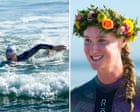
Catherine Breed, a 33-year-old ultra-endurance swimmer from the San Francisco Bay Area, completed the first recorded swim of California’s coastline from the state’s northern-most tip to the Mexico border, finishing on a San Diego beach on Monday. The marathon effort took 111 days and involved daily swims of roughly four to five hours over a period she described as more than 15 weeks in the water.
Breed set out nearly four months ago with a support team aboard the sailboat Catalyst, prepared for sharks and storms but not the year’s historic super El Niño conditions; she and her crew encountered hurricanes, wildlife and 6-8ft waves during the voyage. She told the Guardian that the team had to adapt sections of the route and change plans when weather and currents made progress unsafe or impossible. Over the course of the swim she also reported daily encounters with trash and plastic pollution, and specific concern about sewage runoff near Imperial Beach and the Tijuana River.
Speaking about her mental approach, Breed said: "It is a little bit of an out-of-body experience. Like, I know I’m the one who did it, but there are parts of me where I feel like I’m along with the audience, watching this thing happen. I think I’m still trying to grasp what I’ve done." She described coaching herself through short targets—"coaching myself to get to the next 30 minutes, coaching myself to do the next 2 miles"—and managing technique to protect her shoulders when conditions were rough.
Breed outlined how this challenge differed from earlier marathon swims, noting she swam the English Channel in 2018 and the North Channel in 2019 under English Channel rules, which required "one cap, bathing suit, goggles." For the California swim she wore a wetsuit and shifted her training emphasis toward adding muscle and gym work rather than the cold adaptation she used for those earlier crossings.
On safety, Breed said encounters with sharks were rare and strictly managed: the crew would call, "Shark!" and she would be out of the water within five seconds; such an event occurred only once in four months. She credited part of the deterrent effect to swimming beside a 52ft sailboat and with a tender in the water, and said the team would observe the situation and stop the day’s swim if sharks reappeared.
Breed recounted several notable wildlife encounters and environmental concerns: manta rays, a humpback whale and calf in Morro Bay—"It was so magical"—and a pod of bottlenose dolphins playing in Santa Barbara for about 10 minutes. She also said, "I think we picked up over 10 Mylar balloons in one day," and described the sewage pollution near Imperial Beach as the most nerve-wracking health risk despite taking prophylactic antibiotics.
Weather and ocean currents forced operational changes on multiple occasions: Breed said the super El Niño produced an opposing current that required some sections to be swum south to north so the team could move with the flow. There were days they did not go out and, during Hurricane Rachel, she recounted the wind rising "from about 10 knots to 25 knots (11mph to 29mph) in about seven minutes," which prompted the crew to seek harbor.
Reflecting on the end of the project and her immediate state, Breed said the expedition was far from a solo effort and that she did not always want to swim but felt the commitment extended beyond her personal emotions. On stepping away from the daily routine she summed up the moment plainly: "It feels very weird to wake up this morning and just get to relax."