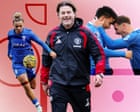
César Azpilicueta: ‘At Chelsea a draw was a catastrophe – if you can’t perform, you’re out’


Former Chelsea defender César Azpilicueta spoke to the Guardian on a terrace west of Madrid, published on 22 November 2026, reflecting on his record-breaking longevity, training-room moments including kicking Eden Hazard, and life after retirement.
Now 37, Azpilicueta said it had been nearly 20 years since his first senior appearance and only a few months since his last match; he recalled his debut for Osasuna as a “One-nil win, Getafe” and said Celta de Vigo were his final opponents in a 1-0 loss for Sevilla in May. He described a career that included more than 800 matches overall and 508 appearances for Chelsea — only five players have played more for the club and no foreigner has exceeded his Chelsea total — and summed up his career in one word: “constancia.” He also cited a cruciate tear with Marseille at 19 as a key lesson that changed his approach to discipline and preparation.
On daily life since retiring he outlined a structured routine: “I get up, take them to school, go to the gym. I do pilates some days. I walk the dogs, play golf, then it’s after-school activities. I read, try to learn new things. I haven’t yet thought: ‘I’m bored,’” and added he had completed an MBA and a sports directorship diploma while receiving media offers. He said playing remains part of his life — matches against his children, a plan to find a seven-a-side team — and that leaving the regular rhythm of playing was a release but not a liberation: “Well, different.”
Azpilicueta described arriving at Chelsea late in the 2012 transfer window, aged 22, with his representative informing him Michael Emenalo and the club were signing younger players; he listed teammates present then — Oscar, Eden Hazard, Victor Moses, Marko Marin, Paulo Ferreira — and recalled integrating quickly with others such as Juan Mata, Fernando Torres and Oriol Romeu, noting practical help from staff: “Petr Cech spoke Spanish. Hazard and I spoke French together.” He told an anecdote about fans calling him “Dave” after a Q&A and said he tried to learn English to settle in.
He stressed adaptability across systems and coaches, noting he had played as a winger in Pamplona and later at right-back, left-back and in a back three after joining Chelsea, and that he worked under “Twelve coaches, in fact.” Reflecting on the club’s demands, he said: “You arrive at a historic club like Chelsea and just try to stay as long as you can. That machine makes demands of you every three days. What I really noticed was a hunger to win: either you have that culture or … forget it. At Chelsea a draw was a catastrophe. You see teammates come and go. The reality is the reality. On the pitch, you have to do it. It’s hard? Yes. But you can’t be sunk by a bad game. If you win: very good, done, next. If you can’t perform, you’re out … You have to manage that pressure.”
On dealing with poor results he recalled a 6-0 loss to Manchester City and described his process: “For me, the first thing would be watch the video. Look at the data. But know that’s not everything. Sleep, get up, turn it round. Get into to training first. And it’s not just about you; some days it’s about lifting up teammates too.” He emphasised meticulous preparation — analysing opponent tendencies such as whether “when the winger receives, he turns left” — and admitted his approach was methodical: “I don’t know if I was more [serious] than others, but I was very cuadriculado, square.”
Asked about Eden Hazard, Azpilicueta praised him as the toughest opponent he faced in training and recalled their dynamic: “He didn’t train 100%, but he forced you to. I had to kick him sometimes, haha! Playing together, he would say: ‘Give me the ball.’ I would say: ‘Stay there, I’ll defend for you.’” On leadership, he remembered first wearing the armband in an FA Cup semi-final against Tottenham in 2017 after Gary Cahill was injured and recounted informal support for new players — “Quite a few stayed at my house” — and practical help when Chelsea’s assets were frozen after Russia’s full-scale invasion of Ukraine, paying for the bus and petrol for first-team and youth players. When asked about that response he said, “Nah,” then added, “Well. No. All of us. I didn’t do anything anyone else didn’t,” and later: “There a feeling of: ‘We have this issue, we’re going to sort this out,’” punctuating the remark with a fist on the desk.
He said lifting the Champions League remains a private memory rather than a display item — “At home? No.” — and described taking a hands-on approach to his final contracts: he negotiated them himself, meeting with Marina Granovskaia, Behdad Eghbali and Todd Boehly, and said he had been comfortable managing that process as captain. He also confirmed practical steps taken since retiring: “I’ve done some co-commentating. I have the MBA, the diploma.”
Azpilicueta concluded that he is enjoying his changed routine and exploring new roles: he has media offers, has completed formal courses including an MBA and a sports directorship diploma, has done co-commentating and continues to plan ways to stay involved in football while balancing family life.