Cristiano Ronaldo retires from Portugal after contested final years

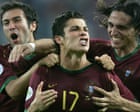
Cristiano Ronaldo has announced his retirement from international football for Portugal, the news reported on 5 November 2026, bringing to a close an extraordinary international career that, Jonathan Wilson argues, was diminished by an extended farewell.
Wilson writes that while Ronaldo’s international record was remarkable, its final phase was marred by an inability to time his exit; he says elite athletes find deciding when to stop especially difficult because an almost unhealthy self-belief is required to reach the top, and that mindset makes accepting an end hard to bear.
Wilson points to the 2022 World Cup as the first clear sign that Ronaldo’s role should change, noting Fernando Santos left him out for the last-16 tie against Switzerland and Gonçalo Ramos, who replaced him, scored a hat-trick; despite Portugal’s improved fluency in that match, he recalls half the crowd chanting for Ronaldo and reports that Ronaldo scored an obviously offside goal, knew it was offside, then performed the "Siuuuu …" celebration and received the biggest cheer of the night.
The article argues that celebrity complicated Ronaldo’s position, saying a cabinet minister publicly suggested he could not be dropped because of the revenue and brand he generated for Portugal; Wilson also highlights Euro 2024, writing that Ronaldo wept after missing a penalty against Slovenia and that his fame shifted attention onto him despite other talented players in the squad.
Wilson describes Ronaldo’s involvement at the World Cup this summer as disruptive, writing that he "gummed the mechanisms, constantly demanding the ball, occasionally drifting out to the left to get in Rafael Leão’s way," and recounts an instance against Spain in which Ronaldo was released on the break but, lacking pace, turned back and played the ball to his full-back, losing the opportunity.
The piece recounts an intervention under Jorge Jesus, "the admirably forthright 72-year-old national coach, who was appointed after the World Cup," saying Jesus did not bring Ronaldo off the bench in the second half of a tight game Portugal ended up winning against Norway; Wilson writes that "Ronaldo insisted he had been promised minutes" and that Ronaldo stormed out of the camp, an episode that concluded with a €255 fine and a 30-day ban covering a period when Portugal had no games.
Wilson concludes that Ronaldo will return to the Saudi Pro League to continue his pursuit of a 1,000th goal, that he will be remembered as an all-time great who vies with Eusébio as Portugal’s foremost player, and that his legacy is in part tainted by a protracted farewell that, in the author’s view, meant a career that might have been greater had it been a little shorter.