Dempsey v Tunney, 1926: Tunney defeats Dempsey in Philadelphia first meeting

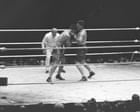
On 23 September 1926 at Sesquicentennial Stadium in Philadelphia, Jack Dempsey and Gene Tunney met for the first time in a heavyweight championship bout; Tunney won every round and took the title.
Jack Dempsey, who bridged boxing’s old and modern eras, rose from a hardscrabble youth to become a national sports figure, fighting roughly 100 bouts as "Kid Blackie" in Colorado, Utah, and Nevada between 1911 and 1914. Biographer Randy Roberts recounts that Dempsey “lived in mining camps and hobo jungles, rode the rods, and more than once begged for food,” and Dempsey himself said, “I was a hobo,” Dempsey said. “But I was never a bum.”
In the ring Dempsey was known for relentless aggression rather than technical defence: trainer Ray Arcel called him “a saloon fighter,” and Paul Gallico wrote, “Dempsey seemed to have a constant bottomless well of cold fury somewhere close to his throat. He had tremendous courage, speed and determination, and good hitting powers. He was never a good boxer and had little or no defense. His protection was aggression.” Dempsey summarized his own formula: “To be a good fighter, you have to have three things. You’ve got to be able to give it. You’ve got to be able to take it. And you’ve got to have a fighting heart.”
Boxing’s recovery from an early-20th-century nadir accelerated after a series of high-profile contests. On 5 April 1915 Jess Willard defeated Jack Johnson in Havana, and in 1919 promoter Tex Rickard offered Willard a $100,000 guarantee to return for a title defence against Dempsey in Toledo, Ohio on 4 July. Willard weighed 245 lbs; Dempsey just 187; after three rounds Willard’s jaw and nose were broken, six teeth had been knocked out and he could fight no more, leaving Jack Dempsey the heavyweight champion.
Dempsey’s appeal helped lift boxing’s public profile further at Dempsey–Georges Carpentier on 2 July 1921 at Boyle’s Thirty Acres, where more than 80,000 spectators attended and the live gate was $1,789,238. The bout was the first world championship fight broadcast blow-by-blow on radio; Carpentier, the reigning world light-heavyweight champion who had served as a decorated wartime pilot, was cast as a heroic, glamorous figure while Dempsey was presented as his opposite. Grantland Rice wrote, “The greatest single day in the ancient history of an ancient sport has come at last; a day that has caught the imagination of more people from crowded centers to remote off-lying places than any single contest since the world’s dim dawn.” Dempsey later recalled, “The Frenchman was the hero. I was the flat-nosed bum.”
Dempsey’s next marquee defence came against Luis Firpo on 14 September 1923 at the Polo Grounds before more than 88,000 fans, with an estimated 35,000 turned away. Ten seconds into round one Firpo dropped Dempsey; the champion rose, floored Firpo seven times, and was then knocked out of the ring, landing in the press section and cutting his lower back on a typewriter before being helped back into the ring. Firpo was counted out at 57 seconds of round two, and Dempsey later recalled, “It was pitch dark for a few seconds. Then I managed to focus on Firpo’s fuzzy form. I don’t remember climbing back in the ring, but I remember seeing 20 Firpos standing in front of me.”
Gene Tunney arrived as a tactical, film-studying challenger whose only defeat in a 67-bout career was a loss by decision to Harry Greb, whom he faced five times; as a younger boxer he had knocked out Soldier Jones on the undercard of Dempsey–Carpentier and had stayed at ringside to watch the main event. During the build-up to Tunney–Dempsey, Paul Gallico wrote, “I think Tunney has hurt his own game with his cultural nonsense. It is a fine thing that he has educated himself to the point where he no longer says ‘dese’ and ‘dem’ and ‘dose’ and where he can tell one book from another and indicate some familiarity with their contents. But the man who steps into the ring with Dempsey with nothing but his hands as weapons needs to be a fighter and nothing but.” Tunney replied, “It never occurred to me that a habit of reading could be seen as a stunt or a joke. Wasn’t reading something we wanted to champion?”
The Tunney–Dempsey fight drew 120,757 fans and produced a gate of $1,895,733, with an estimated 39 million radio listeners; the bout was scheduled for 10 rounds and, as the fighters entered, Tunney was 29 and “only two years younger than the champion.” Tunney cut Dempsey over the right eye, jabbed his left eye shut, and by the end left the champion’s jaw swollen and his mouth bleeding. Dempsey later wrote, “From the time the bout started, I was aware that my body and brain weren’t communicating properly. I was slower than I thought, or Gene was faster. He glided around the ring like he was on ice. Wherever I went looking for him, he stuck that left of his in my face, keeping me off balance, piling up points. Now and then, he’d stop me with a stiff right. There seemed to be nothing I could do, though I tried. Tunney was so scientific a boxer that all I seemed to be able to do was to take his punishment.” After the decision Dempsey said, “I have no alibis to offer,” and later remembered with surprise that, as he left the ring, “To my surprise, I was loudly cheered; more than I had ever been cheered before. The people were cheering for me, clapping for me, calling out my name. I never realized how much I had hungered for a sound like that.”
One year later Dempsey and Tunney met again at Soldiers Field in Chicago before 104,843 fans; that rematch generated boxing’s first $2m gate (the total was $2.7m) and Tunney again won by decision. That second fight is best remembered for the “long count” controversy when referee Dave Barry refused to start counting until Dempsey went to a neutral corner after knocking Tunney down in round seven (the only time in Tunney’s career that he was on the canvas). But that’s a story for next September.