Documentary The Match replays 1986 England v Argentina quarter-final at London festival premiere

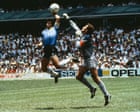
Former England and Argentina players watched The Match, a new documentary about the 1986 World Cup quarter-final between England and Argentina, at a London film festival premiere. The film, directed by Juan Cabral and Santiago Franco, runs 91 minutes — the exact duration of the match — and combines interviews, archive material and personal anecdotes.
Producer Flora Fernandez-Marengo said she persuaded Gary Lineker to take part after he asked, “Is there anything new to say about it?”, by showing him a 1981 photograph of Diego Maradona with Queen; the image depicts Maradona wearing a union jack T-shirt and Freddie Mercury an Argentina strip. The rock’n’roll element, which includes Brian May as a talking head, is one of the few additions the filmmakers made to Andrés Burgo’s book, The Match, on which the documentary is based. Cabral and Franco structure the film by hopping between past and present across the match’s 91 minutes and splice Argentina anecdotes with extensive archive footage.
Jorge Valdano narrates a line in the film: “There are two types of humans,” Jorge Valdano narrates, “Carlos Bilardo and everyone else.” Ricardo “El Gringo” Giusti contributes a personal cábalas anecdote, describing how he buried a sweet in the pitch before kick-off of every game. The directors use intimate material shot by players themselves alongside traditional newsreels to give different textures to the story.
The documentary shows the Argentina squad requesting lighter shirts on the eve of the England match because the official shirts were too heavy when drenched in sweat; footage of women at the squad hotel hand-stitching numbers on light T-shirts bought locally was shot with a handheld camera. Those scenes are presented in direct contrast to grainy archive images of British explorers in the South Atlantic. Interview subjects are filmed in monochrome, widescreen closeups that Cabral described as “like Roman statues,” and the camera often lingers on their eyes.
The Match pivots around Diego Maradona’s two goals from the quarter-final, treating the moments as a contiguous episode rather than two separate strikes. The film inserts a sequence of stills taken by the Mexican photographer Alejandro Ojeda Carbajal to support the handball claim, while noting, with tongue in cheek, that the images “have been credited and licensed through the Englishman Bob Thomas ever since.”
Newsreel material of Margaret Thatcher and Argentinian generals appears alongside a score that includes Queen and Argentinian rock figures such as Charly García, set against wartime imagery. An emaciated soldier is spliced to the voice of a general who dismisses claims the troops were cold and starving: “They probably eat better than they did at home.” Lou Armour, a British veteran, explains he couldn’t see young Argentinians as the enemy, and Cabral says, “We both suffered a tragedy,” adding, “I’m interested in the human duality in which we go from killing each other to hugging each other.”
Spanish and English coexist throughout the film; Valdano reads Juan López y John Ward, a Jorge Luis Borges poem about the war, in Spanish, and Lineker, sitting by his side, utters “very moving,” also in Spanish. A table-football sequence pairs John Barnes and Peter Shilton against Giusti, Óscar Ruggeri and Jorge Burruchaga, with Burruchaga cheering his opponent: “Vamos, Peter!” At the London screening an audience that included young people gave a standing ovation and Shilton was the only cast member present, while the film’s release in Buenos Aires — which coincided with this summer’s World Cup — saw cinemas packed with young people; for a generation in England and Argentina who never saw the 1986 match, much of the material will be new.
The Match opens in UK cinemas from 20 November.