England face France in wheelchair rugby league World Cup final in Wollongong with wider goal of growing the sport

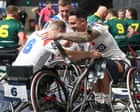
England's wheelchair rugby league side will meet France in the World Cup final in Wollongong, Australia, on Friday as they attempt to retain the trophy won in 2022 and to inspire greater participation in the sport.
Lewis King, captain of England’s wheelchair team, was left partially paralysed in 2009 at age 24 after a blood clot on his spine required an emergency operation; he was later convinced to try wheelchair rugby league by a friend he met while rehabbing at Stoke Mandeville hospital. "It started as a bit of fun and you’d only ever have a couple of family members watching; maybe a dog too if you were lucky," King laughs. "But I fell in love very easily."
The sport's exposure has increased markedly since England's 2022 home World Cup win, when a television audience of almost 2m and about 5,000 spectators in Manchester watched the final. It is described in the report as the most popular wheelchair sport in England by some distance: participation has risen by 110% since 2022, formal league teams have grown from 19 to 42, and clubs including Leeds Rhinos, Wigan Warriors and the new men’s Super League champions, Wakefield Trinity, now operate wheelchair sides alongside girls and juniors teams.
Key individuals underline the squad's on-field quality and off-field influence. Rob Hawkins has been named the Golden Boot winner for the third successive year and is described as the best player in the world; Luis Domingos played professional wheelchair basketball before switching codes after contracting polio as a child; and Halifax's Finlay O’Neill, who was diagnosed with hyper-mobility in his knees and forced to give up able-bodied rugby league, was inspired by England’s 2022 victory and is now part of the 2026 squad. "We speak about that regularly," King admits. "Finlay was watching us at the last World Cup and now he’s scoring tries and playing in a final himself four years later. "There is a pathway for anyone, and we want to show people trauma in life doesn’t mean you can’t play and enjoy sport. We had some young players present our shirts before we came to Australia. That’s the win for us: seeing the next generation want to do it because of us."
On competitive terms England and France are portrayed as the world’s two best teams, with the previous final decided by a margin of four points and expectations of a similarly close encounter in Wollongong. England progressed to the rematch by dismantling Australia in the semi-finals on Tuesday. "I would have liked to have played Australia in the final, with it being over there," King says.
Despite the tournament being behind a paywall in the UK this autumn, the BBC will televise Friday morning’s repeat showdown with France, and organisers expect another large crowd in Wollongong for the final. If you happen to be free on Friday morning, switch the final on and watch England’s stars in action.