Larry Johnson says he fears long-term brain damage after NFL career in interview published 31 October 2026

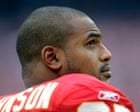
Larry Johnson has spoken about memory loss, intrusive thoughts and his fears about lasting brain damage in an interview published on 31 October 2026. The former Kansas City Chiefs running back, who retired in 2011 after seven NFL seasons and an All‑Pro run, says he can scarcely recall his playing days: "I go up to maybe 2006, 2007," he tells me. "Anything before or three years after, I really don’t remember."
Johnson was one of the NFL’s most punishing backs in the mid-2000s and was known for a physical running style that welcomed contact. At the time CTE was not widely recognized as a risk of playing football; the NFL had evidence linking head injuries to lasting neurological harm but publicly disputed that connection while former players sought disability benefits. The film Concussion — starring Will Smith as forensic pathologist Bennett Omalu, who first raised alarms about CTE after examining the brain of Mike Webster — prompted Johnson to start connecting his own personality swings to the game.
A recent study of former NFL players who died between 2008 and 2023 found 74.5% had CTE, and of the nearly 400 whose brains were donated for postmortem examination 93.5% showed evidence of the disease. Johnson has long suspected he suffers from CTE, though the condition can only be diagnosed after death. He describes intrusive thoughts and memory gaps alongside physical sensitivities that have disrupted everyday life.
Johnson’s pre-draft profile listed him at 6ft 1in and 230 lbs with a 4.45-second 40-yard dash; his college career at Penn State culminated in more than 2,000 rushing yards and the Doak Walker, Maxwell and Walter Camp awards. He had endorsement from Joe Paterno and close guidance from his father, Larry Johnson Sr, described in the interview as a former Nittany Lions defensive assistant who’s now Ohio State’s associate head coach. The Kansas City Chiefs selected him 27th overall as insurance for Priest Holmes.
Chiefs coach Dick Vermeil initially doubted Johnson’s readiness, jesting that he needed to "take the diapers off," but Johnson seized his opportunity when Holmes suffered a season-ending neck injury in 2005, rushing for 1,750 yards and 20 touchdowns in nine weeks. Vermeil later conceded, "Well, he’s a talent." Under Herm Edwards in 2006 Johnson carried a heavy load, gaining 1,789 yards on 416 carries — an NFL single-season carries mark noted in the piece — and Johnson maintains, "People forget: I didn’t get hurt during those 416 carries. I didn’t really start until 2006."
Off-field, Johnson held a Roc-A-Fella ambassadorship and was linked socially to Jay-Z and LeBron James, adopting the "throwing up the Roc" touchdown celebration. He also attracted negative headlines for trade demands, threats to sit out, clashes with coach Todd Haley and the use of homophobic slurs that led to suspensions and his eventual release. Between 2003 and 2012 he was arrested five times in cases involving allegations of violence against women, resulting in convictions for disturbing the peace, domestic battery and assault, with penalties that did not include jail time.
Johnson traces some struggles to early exposure to tackle football, beginning at age nine, and describes post-career life as deeply unsettling: "I couldn’t find anything that really will test your manhood and also test your character like football," he says, and adds, "As twisted as it may sound, the thing I wanted to do was to die on the football field." He reports sensitivity to light, noise and group settings, episodes of paranoia — "If I’m walking, I’ll think, What if something falls out of the sky? Just a constant state of paranoia." — and periods of isolation and substance use that worsened his situation.
A 2017 Washington Post profile prompted a rapprochement with his father — "gave my father new eyes," Johnson says — and around that time the NFL granted him lifetime disability benefits, allowing him to focus on his health. He continues to court controversy on social media but has also discussed plans for an app to connect former players with clinicians; on that subject he said, "I would love to be able to have a symposium for retired guys," so they can share histories and mental health strategies.
Research activity connected to former players continues: Emory University announced a partnership with the Concussion & CTE Foundation and Boston University on a medical study testing whether an FDA-approved drug that reduces inflammation can improve depressive and cognitive symptoms. The study is recruiting men aged 30–55 in the Atlanta area who have played at least 11 years of tackle football, and Concussion & CTE Foundation co-founder Chris Nowinski said, "CTE is both a complex physiological and psychological issue."