Les Kiss’s selection gamble rewarded as Wallabies beat Japan 56-17 in Townsville

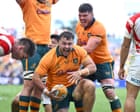
Les Kiss’s reshaped Wallabies beat Japan 56-17 in the return Test in Townsville on Saturday, with several newcomers and squad players delivering eye-catching performances. The victory included a five-tries-to-none second half and offered the new coach multiple selection options ahead of a busy run of fixtures.
Australia produced what the report described as their most promising performance in 12 months, with experimentation evident across the backline and pack. Isaac Henry made an impact on his first start in gold, Hunter Paisami started alongside him in the absence of Joseph Aukuso-Suaalii and Len Ikitau, and Les Kiss used the match to trial combinations with the World Cup next year in mind.
Henry, 27, burst through the Japan line to win the field position that set up the opening try, was hard to tackle and sought metres repeatedly, earning praise for timing his run into the side. The regular midfield pairing was absent: Aukuso-Suaalii is described in the report as the Wallabies’ golden recruit, while Ikitau is noted as perhaps the side’s most consistent player and last year’s recipient of the John Eales Medal.
Flanker Carlo Tizzano registered three takeaways and impressed at openside, prompting Kiss to bring on Fraser McReight to play alongside him in the second half and create a mobile breakdown threat. “It’s a new coaching team, so we wanted to see a couple of combinations,” he told Channel Nine. “We got Fraser on probably fractionally later than we would have liked to, but we had good presence on the ground [at the breakdown], so we’re a good jackal [turnover] threat across the park.” The report also notes the rested Rob Valetini — described as Australia’s best player — is usually deployed at blindside flanker or No 8, where captain Harry Wilson has become comfortable.
Charlie Cale, 25, made his Wallabies starting debut at blindside flanker and scored a late try after shifting into No 8 for the final 15 minutes, which moved Wilson into the second row. Kiss described the positional experiment: “We ended up with Wilso in the second row,” Kiss said. “That’s probably one of the things I want to build, that depth of what every player can do and play. It’s never going to be perfect, we know Test rugby tests you in a different way and challenges you a different way.”
Prop Massimo de Lutiis, 22, came on to become the 1,000th player to appear for the Wallabies and celebrated the milestone by scoring a try; he said: “When Les told me [I would play], I started tearing up a bit and started crying in his lap, which was pretty embarrassing,” he said. “I’m just so stoked. [Cap] 1,000 is awesome, but just to be a Wallaby is just crazy to me.” The match yielded six tries from front-rowers, with the Japanese front row reported to have given up roughly 60kg to the Australians and Taniela Tupou among those who crossed repeatedly.
The report singled out other performers: Queensland-born Harry Hockings was described as the best player in an even first half, returning five-eighth Carter Gordon provided directness and quick decisions, and Japan’s No 10 Ryunosuke Ito was again noted as a talent who could inspire a rugby nation. Despite the margin, those individual displays provided talking points on both sides.
Time for experimentation is running out, with eight matches this year before the sprint to the World Cup, leaving Kiss to decide how to integrate the players who impressed in Townsville into his final plans.