Lewis Hamilton visits Rafah border crossing as US athletes tone down political rhetoric ahead of Las Vegas Grand Prix

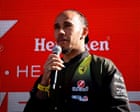
Lewis Hamilton visited the Rafah border crossing between Egypt and Gaza and the Egyptian Red Crescent warehouses in El-Arish on a day Israeli airstrikes and gunfire killed at least seven Palestinians in Gaza, as Formula One returns to the United States this weekend for the Las Vegas Grand Prix. He posted on Instagram: “The past three years of Israel’s genocide in Gaza is appalling,” and added, “I know so many people that feel that same helplessness. That same need to do something rather than watch. I don’t want us to get used to their suffering. I don’t want us to look away.”
Hamilton has a long record of speaking on issues beyond motorsport and stands in contrast to many US sports stars who, the article notes, have “toned down progressive rhetoric considerably during Donald Trump’s second term.” The seven-time world champion is described as the only Black driver in Formula One history and, as Formula One’s most US-facing ambassador, appears at both sporting and cultural events; the piece notes he is a part-owner of an NFL team. That positioning contributes to the attention his activism draws as the series heads to Las Vegas.
During his visit to the Gaza border area Hamilton greeted aid workers in Arabic, toured the checkpoint and saw the Egyptian Red Crescent warehouses in El-Arish where relief supplies are prepared for distribution; he wore dark glasses and dressed head to toe in black. The report states the visit coincided with the day Israeli strikes and gunfire killed at least seven Palestinians, taking a death toll in Gaza above 74,000 since the war began three years ago.
The article recalls Hamilton’s role in driver-led protests in 2020 and 2021, when competitors gathered for a moment of silence wearing “End Racism” shirts; Hamilton and Sebastian Vettel are described as the most consistent kneelers. Vettel, a four-time champion, is quoted: “There was never a second of doubt in my head [about kneeling], first and foremost out of respect for Lewis, and to support him, and the message,” Vettel said.
Hamilton’s public remarks on US politics are referenced, including his 2017 defence of kneeling players: “I think it is open for anyone to have freedom of speech, and I guess we can all play a role in trying to make a difference in the world – particularly if your leader is not helping in that area,” he remarked. The piece also cites his 2020 comment that Trump “turned off the lights and hid in his bunker” during unrest after George Floyd’s killing, and his 2025 interview with Time in which he said: “I’m not going to change what [Trump] does or what the government does,” Hamilton said. “All I can do is try to make sure that in my space, in my environment, I’m trying to elevate people.”
The article outlines Hamilton’s institutional work to increase diversity: he became a founding co-chair of the Hamilton Commission in 2020, whose 2021 report identified barriers in schools, universities and workplace culture and estimated that fewer than 1% of people working in Formula One came from Black backgrounds. Drawing on that report, he launched Mission 44, named for his racing number, and pledged £20m of his own money; by 2026 seven Mission 44 scholarship recipients were working in motorsport, five of them at Formula One teams. The piece also notes Bubba Wallace has cited Hamilton as an inspiration in addressing racial inequality in motorsport.
On the grid, the article says Hamilton helped change its racial makeup and now races alongside drivers such as Isack Hadjar, Alex Albon and Arvid Lindblad; it mentions Ugo Ugochukwu became Formula 3 champion in September and is reportedly slated to drive practice sessions for Cadillac in 2027. Hamilton’s comment during the Spanish Grand Prix weekend is quoted: “It’s been amazing to see his rise through the class,” Hamilton said. “Really exciting for next year.” The story also records that bringing a Formula One race back to Africa has been a long-running ambition, and that last month’s announcement of an African Grand Prix in Rwanda marked the realization of that goal.
Hamilton, now 41, told the media he wants to be on the grid when the Rwanda race debuts in the early 2030s, and after the announcement he expressed excitement at racing in Rwanda and showing the country off to the world while acknowledging urgent human-rights concerns surrounding Rwanda. The article adds that he has a history of calling out Formula One for “getting into bed with autocratic regimes.”
The report says Hamilton’s pro-Palestine stance carries commercial and professional risks: it could cost him financial backing and, the piece contends, make him more vulnerable at Ferrari, where he and teammate Charles Leclerc are described as locked in a power struggle and with free agency potentially looming for Hamilton again after the 2027 season. As the sport moves to Las Vegas this weekend for the Grand Prix, the contrast between Hamilton’s outspoken activism and the reduced political rhetoric among many US athletes is likely to be noticed by American fans.