Lionel Messi ends Argentina career with farewell at Monumental after Benin match

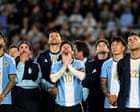
Lionel Messi confirmed the end of his Argentina international career after his final appearance for the national team against Benin on Tuesday at the Monumental Stadium, bringing to a close a brilliant international career this week.
Jorge Messi’s long-held aim for his son to be embraced by Argentina shaped Lionel’s international path: he grew up in Barcelona’s youth system and was eligible for both Spain and Argentina, and his debut for Argentina in a youth match against Paraguay sparked a rush to secure his allegiance. Jorge sent videos to then-manager Marcelo Bielsa to expedite the process, and for a long time Lionel was little known in Argentina despite being one of Barcelona’s academy’s most promising players.
Public expectation and scrutiny accompanied Messi throughout his career, often focused on his reticence in interviews and public speaking. Brazilian writer Milly Lacombe posted that “What Argentina is doing in this World Cup is of a sacred order,” and described the contradiction of “a player who is a God and a man who shakes Trump’s hand,” questioning Messi’s silence over racist incidents surrounding the team. Journalist John Carlin said that having interviewed Messi twice he would decline a third opportunity because of the difficulty of getting him to speak at length, and Juan Sebastián Verón recalled in 2010 that he had never seen Messi so nervous as when he first addressed his teammates as Argentina captain; Messi’s most famous on-field outburst was telling a Dutch player to “go away” at the 2022 World Cup.
Argentina’s public fortunes shifted markedly: the team were darlings after winning the World Cup in 2022 but were widely reviled following the 2026 final defeat to Spain. Lacombe described the semi-final against England this summer and said: “That’s why it’s important to understand that when Messi, in the middle of a game that was lost, looks at the sky, and then after that he turns the game around and smashed it, there is something very mysterious there. Right? That we can’t explain. That we just feel.” She added that she began by supporting England but ended the match “weeping, surrendered to the commitment, the passion, the love that I saw the Argentina team pour on to the pitch.”
Criticism of Messi has been recurrent and often harsh: pundits once staged a minute’s silence in protest at his performances, he was chastised for not singing the national anthem, and the press targeted him more than the public at times. Reports emerged that he suffered bouts of vomiting and diarrhoea before matches, Diego Maradona mocked him as no leader before later naming him captain, and when Messi quit the national team in 2016 a spontaneous national show of support led him to reverse the decision. Argentine journalist Alejandro Wall said: “What characterized Messi in the national team is that he lost. He lost a lot. He’s constituted in defeat.”
The player’s role evolved notably after 2020: the article says Messi walked taller and appeared more confident in leadership following Diego Maradona’s death, and Argentina won the Copa América in 2021. Snippets of Messi’s pep talks to teammates surfaced, and commentators noted his Rosario accent, describing him as “aspiring the ‘s’ and not pronouncing most final consonants.” The Argentinian Football Association subsequently prioritised finding a coach able to adapt the system around him.
Tuesday’s farewell at the Monumental carried an improvised air: the Argentinian FA struggled to secure opponents and was criticised for arranging matches against Bolivia and Burkina Faso in the same window, with Lionel Scaloni reportedly referring to a desire to face bigger opponents. Burkina Faso sent an Under-23 side who arrived a few hours before their match, the stadium was not filled to capacity, ticket prices were called extortionate by some fans who labelled the arrangements “a scam,” and terraces chanted against AFA president Chiqui Tapia. Tributes included Soledad Pastorutti singing the same number she had once performed with Maradona, a veteran of the Falklands/Malvinas War singing the national anthem and draping himself in the same flag that fell on the pitch in Atlanta, a drone show advertising an insurance company, and Messi receiving an honorary doctorate from the University of Buenos Aires in a small ceremony at the AFA.
On the pitch Benin posed a challenge and their captain presented Messi with a statue of a Dahomey Agojie; Messi set up three of Argentina’s three goals and scored a penalty he did not miss, and the crowd’s mood swung to celebration. After the match Messi addressed conspiracy theories about the World Cup final, saying: “Nothing odd happened. The match against England wore us out at an emotional level,” and he urged unity while acknowledging difficult times ahead: “We had the dream of fulfilling our dream,” he said, adding: “I don’t know, I’m talking more than ever. I don’t want to leave here. I love you”.
When he confirmed he would end his international career — his final appearance for Argentina came against Benin on Tuesday — the nation responded with a wave of grief and gratitude, and the match served as a final public moment in which Argentina and Messi were exchanged between reproach and affection.