Manchester City v PSG recalls alternate routes taken in past UEFA sanctions disputes

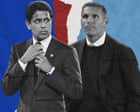
Nasser al-Khelaifi attended Paris Saint-Germain’s trip to Manchester City’s Etihad Stadium for a Champions League match on Wednesday and his presence served as a reminder of the different approaches the two Gulf‑owned clubs have taken in past sanctions battles after al‑Khelaifi objected to the timing of the Premier League’s release of Manchester City’s guilty verdict a fortnight ago.
Both clubs were among the first found to have breached UEFA’s financial fair play rules in 2014; investigators concluded the scale of the shortfalls between 2011 and 2013 far exceeded the then maximum permitted loss of €45m, yet both sides avoided formal charges by entering settlement agreements.
UEFA’s investigators recorded PSG’s deficit as €218m and Manchester City’s as €188m for 2011–13; the settlements imposed a €20m fine on each club and additional restrictions on spending in subsequent years, with a further €40m liability if the terms were breached, and UEFA said in April 2017 that both clubs had "fully complied with all the requirements".
In 2020, UEFA’s investigatory chamber suspended Manchester City from the Champions League for two years for "overstating its sponsorship revenue" between 2012 and 2016, a sanction that was later overturned by the Court of Arbitration for Sport, which found: "Most of the alleged breaches were either not established or time‑barred."
Last month the Premier League disclosed that an independent commission examining more than 100 charges had found Manchester City, between the 2009‑10 and 2017‑18 seasons, to have been "significantly in breach" of UEFA’s spending limits and to have "filed misstated accounts and concealed the true state of its finances"; City have appealed the commission’s verdict.
Paris Saint‑Germain received a further UEFA fine of €10m in 2022 for not complying with financial rules since 2018, with an additional €50m suspended, and al‑Khelaifi expressed annoyance that the release of the independent commission’s core judgment on City overshadowed the European Football Clubs general assembly in Copenhagen, where his keynote speech included Manchester City chief executive Ferran Soriano sitting in the front row before scurrying away from television cameras.
Al‑Khelaifi used his address as EFC chair to outline plans to make the organisation global and to criticise FIFA president Gianni Infantino on governance; a 2018 Der Spiegel investigation claimed Infantino, then UEFA’s general secretary, had helped secure lighter outcomes in 2014 through meetings described as "secret talks, even supplying them with confidential materials" that included suggested "compromises that he was unauthorised to propose". Der Spiegel published an email from Infantino to City’s chair, Khaldoon al‑Mubarak, sent on 2 May 2014 in which he wrote: "You will see that I’ve sometimes chosen a wording which ‘looks’ more ‘strong,’" and added, "Please read the document with this spirit." Settlements were agreed in May 2014 after those exchanges, and Brian Quinn, the head of UEFA’s investigatory chamber and a former senior official at the Bank of England, resigned amid reports he considered the agreements too lenient.
UEFA defended settlement agreements at the time, saying: "In cases where clubs overspend and balance their books only thanks to money injections, a settlement agreement has always been the preferred solution," and adding, "In such cases, the focus is on limiting the revenues coming from outside football." Infantino has said his "job entails having discussions, having conversations, exchanging documents, drafts, ideas" and that he had been carrying out his duties "in an honest way, in a professional way and trying to defend the interests of football". PSG insist they have "always acted in full compliance with the laws and regulations enacted by sports institutions" and City’s protestations of innocence are well established; the two clubs now occupy contrasting positions, with al‑Khelaifi portrayed as part of the establishment through the EFC’s joint shareholding with UEFA in the commercial company that runs the Champions League, while City remain vocal critics of football’s governing bodies.
Many City supporters will continue to show their disdain for UEFA by booing the Champions League anthem, and Manchester City have lodged an appeal against the independent commission’s verdict.