Mystery over whether Wrexham’s Peter Baines was the first Indigenous Australian to play abroad

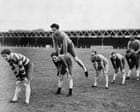
Peter Baines, who played for Wrexham and other English clubs during the 1930s and 1940s, may have been the first Indigenous Australian to play football overseas, a claim that remains unresolved. Writers, historians and researchers continue to investigate his origins to establish whether he was born in Australia.
Wrexham, the club where Baines scored 27 goals in 35 games in one wartime season, has drawn renewed interest in its early black players following its rise through the English Football League and ownership change in 2021. Baines also played for Oldham, Crewe and Hartlepool and turned out as a wartime guest, scoring for Liverpool in an exhibition match; contemporary newspapers described him as "a real go-ahead player" and "one of the best number eights in postwar combination football". After Baines scored at Anfield, it was more than three decades before Howard Gayle — widely recognised as Liverpool’s first black player, later involved with Show Racism the Red Card and offered, and turning down, an MBE in 2016 — made his debut. The man newspapers called Peter "Darkie" Baines died in 1997 in Manchester at age 77.
Australian journalist Trevor Thompson first noticed Baines’s story more than 20 years ago after finding a 1944 report in Hartlepool’s Northern Daily Mail that praised his recent performances for Hartlepools United and stated "Peter is an Australian" and "As a boy he came with his parents to Liverpool ...". Thompson, a longtime journalist from Sydney, said: "Why would anybody bother saying that if it wasn’t the case? That lingers in my head." He has been tracing family links and records in pursuit of definitive proof.
Some writers accept Baines’s Australian connection. In his 2003 book, Nick Harris described Baines as "the first Australian of Aboriginal descent in the League" while noting there is conjecture about his birthplace: "Some sources claim he was born in Manchester, where he was raised in an orphanage. But it seems he was quite possibly born in Australia and only later transported to the orphanage as a result of the repugnant [forced assimilation] policy." A Daily Mail article three years ago also identified Baines as Australian and said he "almost certainly didn’t travel to the other side of the world by choice"; OzFootball lists his career and Ancestry.com records his birthplace as Australia, though those sources are described as unclear, and a family social media post said they had traced his ancestry and discovered he was a "native Australian".
Research by Bill Hern, author of Football’s Black Pioneers, offers a contrasting view. Hern says he has located a Manchester birth record for a Cecil Peter Baines whose date of death matches the former player and wrote: "I have to say that I am 99% certain that Baines never set foot in Australia but I’ll leave you to make your own judgement," via email. Hern has been unable to settle Baines’s racial background despite research that covered army records, birth and death certificates, news clippings and inquiries with Australia organisations; he cannot find evidence that Baines was taken from an Indigenous birth mother as part of the Stolen Generations nor that Peter senior was black. "The nearest suggestion is a reference on the Habitual Criminals’ Register to him being ‘swarthy'," he wrote. "More significantly, when Peter senior was on the run after escaping from prison his very detailed description did not include any reference to him being dark-skinned. Nor is there anything to suggest that Peter junior’s mother Alice was black." Hern has written extensively on Baines, who was also Crewe’s first black player.
Proponents of confirming an Australian link say the finding would be historically significant. Professor John Maynard of the University of Newcastle, a Worimi man, said: "These stories need to be unearthed and revealed because I’ve always said Aboriginal history is like a giant jigsaw puzzle with most of the pieces not on the table." Maynard added: "As far as Aboriginal participation in sport, we had cricketers and jockeys and athletes in the later 19th century, but then a lot tighter control came over Aboriginal people’s lives and their participation in sport was cut off basically through the colour bar." Trevor Thompson said he is optimistic about a resolution, noting he is close to a breakthrough "through tracing family links and unsealed church records," and stated: "The idea that there could be an Indigenous Australian professional player in that era makes them unique and certainly the first."
Newspaper clippings record other facets of Baines’s life, including court appearances and references to alcohol and gambling, but accounts after his death in 1997 recall affection and regard for his footballing ability; correspondence described his "smiling face" and called him a "smashing story-teller and could laugh at himself", and all remembered him as a very good footballer.
Clarifying Baines’s connection to Australia remains an active objective for researchers, with Thompson pursuing family lines and church records to establish his birthplace; a confirmed link would, according to Maynard, make Baines an important historical figure within the chronology of Indigenous Australia.


