Netflix’s Untold Raygun: Breaking Badly follows Rachael Gunn but avoids a key question about breaking’s Olympic reputation

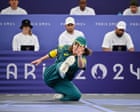
Untold Raygun: Breaking Badly, which premiered globally on Netflix on Tuesday, profiles Australian B-girl Rachael Gunn and her sudden notoriety at the Paris 2024 Olympics, but the film largely sidesteps what her fame meant for the sport of breaking.
The documentary opens with Gunn recounting a session with her sports psychologist before the Games: "Right before the Olympics, I went to my therapist, panicked," she says, and after she admitted her worst fear — "The whole world could laugh at me." — her therapist asked, "Do you think that's reasonable?" Gunn’s Olympic cypher, featuring moves such as the sprinkler and kangaroo hops, went viral almost immediately, generating memes, late-night segments, conspiracy theories and even a musical at the Edinburgh Fringe Festival; fellow Australian B-girl Flix says, "She became the most famous breaker on planet Earth overnight," despite Gunn receiving no votes from any of the nine judges across her six rounds.
The film concentrates on Gunn’s personal story through interviews with her parents, her husband Sammy Free, and dancers from the Australian scene, tracing what the documentary frames as a coming-of-almost-middle-age arc in which an academic meets a B-boy at a call centre, falls in love and ultimately finds herself on the Olympic stage. Gunn is presented as likeable, "(mostly) self-aware and self-deprecating," and her family are shown reacting with amusement when asked whether they had ever associated "Olympian" with their daughter; the documentary’s principal perspectives are rooted in her immediate circle rather than the wider breaking community.
Two Australian B-girls provide the film’s most critical commentary on Gunn and on women’s place in the scene. Tinylocks invokes the ethos of "No easy props," saying, "It was such a male dominated space and B-girls were really fighting to be seen but as more women started entering breaking, it was felt that some girls were getting accolades too early in their careers. The crowd would cheer just for participating," and later offers a measured view of Gunn's early sets: “There were one or two times when I was like, ‘Oh yeah, that was fresh.’ Maybe not so much the other times.” Tinylocks says she opted not to attempt the Oceania qualifying spot; Flix did compete at the Oceania qualifier but, at 41, did not expect much.
At the Oceania qualifier Gunn advanced to the final battle against B-girl Molly, but the film notes that those sets did not include the Olympic-era "iconic" moves and were marked by relatively slow, less-sharp movement that nevertheless reflected standard breaking foundations. After poor showings at several European battles in the months before Paris, Gunn and Free shifted strategy away from attempting high-difficulty power moves and instead emphasised originality — one of the five categories judged at the Games, with the other four listed as technique, vocabulary, execution and musicality — aiming simply to capture a single vote from one of the nine judges.
Despite that tactical change and the incorporation of playful references to Australian wildlife, the sprinkler and a nod to swimming, Gunn did not receive any judge votes in Paris. The documentary contrasts her reliance on character-based gimmicks with examples of athletes whose online memes were tempered by elite results: Stephen Nedoroscik, the 2021 world champion on pommel horse who won bronze at the Olympics, and Turkey’s Yusuf Dikec, who became a meme but won silver in shooting. Gunn addresses online reaction herself, saying, "People have a lot of opinions about what women do, what women should do, sometimes from women," and the film also disputes the false conspiracy claims that she "cheated her way to the Olympics."
The documentary places Gunn among a lineage of widely publicised but unorthodox Olympians — Eddie the Eagle in 1988, Eric Moussambani in 2000 and Elizabeth Swaney in 2018 — and notes a distinguishing factor: breaking was new to the Paris programme, yet Gunn left the Games as the most famous breaker in the world, with many viewers more likely to recall Raygun’s performance than the competition winners. The film does not fully interrogate what that outcome means for breaking’s cultural origins or its global perception.
The documentary also omits a related selection detail: "that breaking won’t appear at LA2028 has nothing to do with Gunn. The decision was made months before she hopped across the cypher." Last week WDSF submitted breaking for consideration for the 2032 Olympics, which will be hosted by Brisbane. If the local organizing committee decides to give breaking another shot at Olympic glory then perhaps we’ll see Gunn again, but hopefully not at the center of the cypher.
