Pat Cummins faced reporters at home in Sydney as sandpaper saga deepens after Bancroft statement

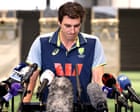
Pat Cummins was confronted by television reporters outside his Sydney home on Thursday as the sandpaper saga involving Cameron Bancroft and Usman Khawaja continued, after Bancroft published a 4,000-word statement overnight.
Several figures associated with Australian cricket passed through Hobart airport on Thursday, including Cricket Australia executive Todd Greenberg, described as wearing a suit and pulling a trolley suitcase while on his phone, and former coach Darren Lehmann, described as dressed down with a backpack and a can of Coke. Cummins had delivered a 68-minute press conference in response to Usman Khawaja’s book revelations the previous week and was described at the time as statesmanlike; his camp had given themselves a few days to war-game responses in advance.
At his front door, reporters shouted questions about Bancroft’s statement, his job security, whether he had been “thrown under” the bus, and claims in the English media calling for him to be sacked; one of the questions posed as he left was “Do you think it’s gotten out of hand?”. Cummins replied on the doorstep, “You’re probably not that sorry though, are you?” before kissing his wife goodbye and climbing into his car to head to training with his New South Wales teammates.
During last week’s presser Cummins answered a pointed question with a single flat “No”, denying any knowledge of ball-tampering at any point during that South Africa tour and saying he had no recollection of a meeting where collective responsibility was discussed. The captain publicly questioned Usman Khawaja’s credibility in that appearance, describing him as “casual” with the truth and friendships and referring to him as a “sneaky so-and-so who jotted down notes at the time ‘to release a book one day’.” He has also been referred to by teammates as “7-Eleven”.
Bancroft’s detailed, 4,000-word account—now published by the Guardian—does not merely repeat Khawaja’s version, according to the reporting, but expands on it; the piece records names, quotes and claims of knowledge about sandpaper that extend to the tour media officer. Chadd Sayers has lent his support to Bancroft’s account, which the article says contained a few inconsistencies but “sounds far, far closer to the truth.”
Cummins’s management maintains that none of what he said last week has been undermined, while Cricket Australia’s Todd Greenberg on Wednesday asserted that conflicting “truths” can co-exist. A poll on the Code Sports website of more than 10,000 readers showed 72% voting “no” to whether Cummins should remain as captain, and the piece notes he is not universally popular in Australia because of his progressive views on issues such as climate change.
The article recounts that Cummins has played a prominent role in reshaping Australia’s post-sandpaper image by winning while displaying a less confrontational demeanour on the field. It also recalls the wider fallout from the original incident: the prime minister intervened, and Cricket Australia imposed sanctions on Cameron Bancroft, David Warner and Steve Smith; when James Sutherland, chief executive at the time, announced those punishments after the rapid investigation in South Africa he said he was “absolutely satisfied” that sandpaper was a one-off and that only three players knew, a version that the article says held until a fortnight ago.
Cummins has chosen his course since the controversy re-emerged, and the article concludes that the ripple effects from the rushed containment in 2018 may cost Australia another captain.