Premier League orders tougher policing of holding at set-pieces

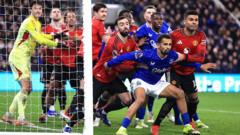
Players from both sides were camped inside the six-yard box when Everton met Manchester United in February in the Premier League last season, a scene that underlined widespread holding and grappling at corners. The league has drawn up new guidance aimed at reducing those non-footballing actions ahead of the new campaign.
Holding, pushing, shoving and grappling inside the penalty area became described as an epidemic last season, with Everton manager David Moyes saying: "You get the feeling now that referees really don't want to get involved in any of it," and adding: "It's really poor that they've not tried to deal with it." A West Ham disallowed goal against Arsenal in May — where up to five potential fouls occurred simultaneously — was cited during summer consultations with captains, coaches, referees and other stakeholders.
The laws themselves remain unchanged, but officials across competitions, including the English Football League and the Women's Super League, will now pay closer attention to "holding actions that have clear material impact." The guidance prioritises incidents in which a player is prevented from playing the ball, and the review of last season's VAR work identified that of 20 missed VAR interventions, a quarter were penalties not awarded when a player had been wrestled to the ground off the ball.
The league has defined the types of behaviour it will target as "non-footballing holding actions that have no place on the football pitch," including situations where a player is only focusing on the opponent (not looking at the ball), making no attempt to play or challenge for the ball, holding an opponent with both arms, or committing sustained and/or impactful holding of an opponent or their clothing. A defender whose back is to where a set-piece is coming from and whose sole intent is to stop an attacker's movement will be penalised under the new emphasis.
Howard Webb, head of the Premier League referees, said officials should be more proactive: "We're trying to get the officials to be as confident as they can be to penalise what they see," and added: "So fewer warnings, more actions penalised, and if there's any reduction in offences being penalised it should be a result of a modification of player behaviour rather than us no longer applying it." He also cautioned that contact remains part of the sport: "Contact is still part of the game, we still maintain the high threshold," while noting a goalkeeper whose arm movement is restricted would still be penalised — citing Arsenal's David Raya against West Ham as an example.
Pro Ref, the new name for the referees' body in England, has been visiting training grounds over the summer to show incidents and run through expectations; feedback from clubs has varied. Players were shown clips of two incidents that were not ruled penalties last season but would be under the new guidance: Brentford's Keane Lewis-Potter wrestling West Ham's Tomas Soucek at the far post, and Sunderland's Luke O'Nien dragging down Leeds United's Pascal Struijk with an arm around the neck.
Webb described how opinions can split on borderline cases, citing Crystal Palace's Marc Guehi being pulled down by Bournemouth's Bafode Diakite and the referee awarding a spot-kick: "One player will tell you that if a penalty is not given, they expect the VAR to be involved, knowing full well that that will highly frustrate the other half of the room, who don't see a penalty in the first place." He said giving Guehi the penalty on the field was acceptable but "it should not be a VAR intervention," and outlined how pre-game dossiers help officials identify likely problems and position themselves to get better angles.
Set-piece play was a major source of goals last season: the Premier League recorded 269 goals from set-pieces excluding penalties and direct free-kicks, with set-pieces accounting for a record 25.7% of goals across Europe's top leagues; Serie A was on 22.3% and the World Cup on 17.5%. Arsenal scored 25 set-piece goals and conceded seven from set-pieces; Manchester United scored 21 and Tottenham Hotspur 19. At the other end of the scale, Liverpool conceded a league-high 19 goals from set-pieces, with Chelsea and Newcastle on 17. There is scepticism around whether clampdowns on holding will be sustained, and the article notes the task is to prove this is not a short-lived policy.
Webb said officials expect change if enforcement is consistent: "If we start penalising offences, players have to adjust their tactics." The Premier League season will get under way on Friday night when champions Arsenal host promoted Coventry, at which point referees have been told to apply the new emphasis and penalise clear non-footballing actions.