Premiership defences push back after try-heavy opening rounds

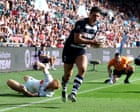
After the opening two rounds of the English Premiership this season, round one produced a record try haul and round two yielded 41 tries, prompting debate over whether the club game is drifting towards a basketball-style spectacle. The early results have split opinion on whether the league is genuinely becoming more attack-focused or if defences remain decisive.
A remarkable first weekend suggested an attack-led trend, but the second round offered counterexamples where defences shaped outcomes: Sale’s gritty win over Saracens was a defensive dogfight, Leicester’s victory over Newcastle lacked aesthetic fluency and Bristol scored six tries against Northampton while their overall success owed much to defensive work. There was a pre-season consensus that rugby is cyclical and that periods favouring attack will be followed by stronger defensive phases, a view reflected by Exeter’s director of rugby Rob Baxter, who said: “The game ebbs and flows.”
Sale’s resilience against Saracens underlined the defensive argument; the side held out despite losing Jacques Vermeulen to a red card on the 20th minute. Courtney Lawes, back in the Premiership with Sale after two seasons in France, commented on the scoring pattern and the importance of defence: “A lot of tries, 40 points, 30 points each way, that’s quite interesting,” Lawes says. “It’ll be interesting this season. It might be the team that’s got the best defence that actually wins the league. When you’ve both got 50 or 40 points on the board, that’s a pretty open game, isn’t it? So defences have got to tighten up. I understand why the attacking game is important, but if you can equally have a good defence, then you’re going to win more games than the boys that are only interested in attack.”
Northampton’s defeat at Bristol is a case in point: the match produced 10 tries but did not become the expected attacking exhibition, illustrating that teams can both defend well and still concede multiple scores. Northampton director of rugby Phil Dowson rejected the ‘‘becoming basketball’’ refrain: “I see a lot of comments around ‘it’s becoming basketball’ but I don’t think there’s any lack of intent in defence. I don’t think we’re not defending.”
Dowson placed the trend in a cyclical context and cited past defensive revolutions as precedent: “I’ve no doubt in my mind that, like in the NFL, it ebbs and flows between attack and defence,” he said. “Sometimes the attack is very popular and sometimes the defence comes out on top. When Shaun Edwards came in at Wasps and changed the game when I was playing, that was a step-change in defence. Everyone complains, ‘It’s 9-3, 12-6,’ now we’re going, ‘Oh it’s 48-32’ – what do people want? That’s the question isn’t it, what do we want the game to look like?”
Former player Geoff Parling offered a complementary view on match quality, noting that try counts do not automatically equate to good contests: “The product on the pitch in general is decent,” Parling said. “Lots of tries scored, although I would say that doesn’t necessarily equal a good game for me. I think 9-8 can be a beautiful game, in the right way, a genuine gladiatorial contest with physicality going at each other. I think try-scoring in general is a good thing, but it doesn’t necessarily mean it is a good game.”
Changes in officiating and breakdown policing have fed into the discussion. England head coach Steve Borthwick has instructed referees to alter interpretations of certain laws to prepare his side for Australia next year, and officials have called an eye-catching number of offside penalties in the opening rounds. According to Oval Insights there were 15 penalties for holding on in the first round and 18 in round two. Dowson highlighted the breakdown work in Bristol’s win and singled out a performer: “We try to correct [the breakdown] every day, every minute of the game, all the time because that’s the game,” he said. “I don’t know how many lineouts, between 12 and 15, I don’t know how many scrums, but 200 breakdowns, so whenever you get tackled the ball is in that situation. They did a very good job, Fitz Harding was exceptional.”
It is too early to draw firm conclusions about a lasting shift in the Premiership’s balance between attack and defence, and whether Borthwick’s refereeing instructions are already influencing domestic games remains unclear; he may, however, have been happier after the second round than the first. The evolution of officiating and breakdown enforcement will be watched closely as the season continues and as international preparations for next year proceed.