Ranking the best managers in Premier League history

BBC Sport published a ranking of the best managers in Premier League history on 25 August 2026, placing Sir Alex Ferguson at number one and Pep Guardiola second. The feature lists the 13 managers who have won the Premier League and explains why some title-winning and long-serving figures missed the top spots.
The article begins by noting titles are a natural starting point and that only four managers have won more than one Premier League crown since the competition began in 1992. Longevity is highlighted: David Moyes has managed 755 Premier League games, behind only Arsene Wenger's 828 and Sir Alex Ferguson's 810, and Moyes' 291 Premier League wins — across spells with Everton, Manchester United, Sunderland and West Ham — trail Wenger's 476 at Arsenal and Ferguson's 528 at Manchester United. Harry Redknapp ranks fourth for games managed (641), fifth for wins (236) and completes the top five for goals scored (818). The piece also flags Mauricio Pochettino as the only manager with more than 100 Premier League matches who has not won the title yet has a winning percentage above 50; it states that 13 managers in total have taken the title, leaving three recent figures out of the list, including Arne Slot, with Manuel Pellegrini and Antonio Conte also omitted. Pellegrini's record is noted: an average of 1.92 goals per game across his three years at Manchester City and 17 months at West Ham ranks fifth among managers with at least 100 matches, but a subsequent poor run at West Ham and heavy spending meant the Chilean — described in the article as the Engineer and the only manager from outside Europe to win the title — did not make the cut.
At number 10 the article places Carlo Ancelotti, with a note that he is a title winner in 2009-10 and has won domestic championships with AC Milan, Bayern Munich, Paris St-Germain, Real Madrid and Chelsea. The piece records that Ancelotti won the Premier League at the first attempt with Chelsea, oversaw the club's 8-0 win over Wigan to clinch the 2010 title, signed Fernando Torres for a then-British record fee the following January and was dismissed after Chelsea finished as runners-up in his second season; it adds that he later returned to England with Everton and delivered successive mid-table finishes before leaving for Real Madrid. Mikel Arteta is ranked ninth as the 2025-26 Premier League winner and the first Arsenal manager to lift the trophy since Arsene Wenger in 2004; the article says Arteta ended an eight-year run of either Manchester City or Liverpool winning the title and describes him as the only current Premier League manager who has won the trophy, while noting Arsenal added to their squad that summer. Roberto Mancini appears at eight for his 2011-12 title, with the piece recounting City's dramatic final-day victory decided by two goals in added time, including a 94th-minute winner, and noting he replaced Mark Hughes in December 2009, won the FA Cup in his first full season, achieved the fourth-best points-per-game of managers with at least 100 Premier League matches (ranking above Antonio Conte and Jose Mourinho) and oversaw a City side that averaged the fewest goals conceded at 0.83 per game.
Kenny Dalglish occupies seventh after winning the top flight with Blackburn in 1994-95; the article traces his earlier success at Liverpool — three titles in four seasons before the Premier League era, initially as player-manager — and records his departure from Liverpool in February 1991 after almost 15 years. It describes his work at Blackburn, promoted via the play-offs, where Jack Walker's backing led to signing Alan Shearer from Southampton for a British record fee of £3.6m and then to a title in 1995 that made Dalglish the fourth manager to win the English top flight with two different clubs. Claudio Ranieri is sixth for masterminding Leicester City's 2015-16 title as 5,000-1 outsiders and for finishing second with Chelsea in 2004 during Abramovich's first wave of spending, a season in which Chelsea lost to Monaco in the Champions League semi-finals. Jurgen Klopp is fifth after delivering Liverpool's 2019-20 Premier League title, the club's first in 30 years and their first of the Premier League era, with the article pointing out Liverpool recorded more than 90 points on three occasions under Klopp while winning one title.
Jose Mourinho is fourth, credited with Premier League titles in 2004-05, 2005-06 and 2014-15; the piece recounts his arrival at Chelsea after winning the Champions League with Porto, his self-description as the "Special One", Chelsea's 12-point title-winning campaign in which they conceded only 15 goals, his departure in September 2007, a return six years later that produced a third Premier League crown in his second season before he left by the following Christmas, and later spells at Manchester United and Tottenham Hotspur. The article notes Mourinho is one of only three managers to win successive Premier League titles, alongside Sir Alex Ferguson — who achieved three in a row twice — and Pep Guardiola, who achieved four in a row.
Arsene Wenger is third, listed with Premier League titles in 1997-98, 2001-02 and the unbeaten 2003-04 season; the piece records his move from Nagoya Grampus Eight, his role in professionalising Arsenal, and that he did not win another title in the 14 years that followed his 2003-04 success. The article includes Jose Mourinho's earlier comment that Wenger is a "specialist in failure" and describes the Arsenal team Wenger built in his first decade as among the best seen in the Premier League.
Pep Guardiola is ranked second, with Premier League titles in 2017-18, 2018-19, 2020-21, 2021-22, 2022-23 and 2023-24; the feature records that Guardiola's Manchester City won six Premier League titles during his decade in charge, were the first English men's side to win four consecutive titles, and reached a century of points in 2018, while the article also states he influenced the game at elite and grassroots levels and benefited from substantial backing in the transfer market.
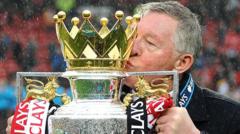
Sir Alex Ferguson is placed at number one, credited with Premier League titles in 1992-93, 1993-94, 1995-96, 1996-97, 1998-99, 1999-2000, 2000-01, 2002-03, 2006-07, 2007-08, 2008-09, 2010-11 and 2012-13; the article says he dominated the first two decades of the Premier League, repeatedly rebuilt Manchester United across eras from Eric Cantona and the 1999 Treble winners to later front-line attacking trios, continued winning titles up to his retirement in 2013 and holds a haul more than double any manager from any era of men's English top-flight football, with Guardiola, Liverpool's Bob Paisley and George Ramsay for Aston Villa next on six.