Rattled All Blacks head to Twickenham after 35-28 loss to Wales, face rare risk of consecutive defeats to England

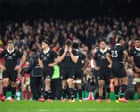
After their 35-28 defeat by Wales on Saturday, New Zealand will travel to Twickenham this weekend for the 48th meeting with England and confront the prospect of an uncommon run of successive losses to the same opposition.
The last time the All Blacks lost twice in succession to England was in 2002-03, a period that, like now, arrived with a Rugby World Cup looming in Australia and a squad rich in talent; as Steve Hansen said at the time, “There is so much talent in New Zealand that, if they don’t win the World Cup, there should be an inquiry.” A fresh inquiry has been prompted by the Cardiff result, with senior players including Beauden Barrett and Richie Mo’unga coming under scrutiny after tactical shortcomings late in the Wales game. Barrett captained New Zealand for the first time in that match while earning his 149th cap, and it remains uncertain whether he will reach 150 this Saturday. Reinforcements such as Codie Taylor, Damian McKenzie, Cam Roigard and Jordie Barrett are available for selection, and forwards coach Jason Ryan said last year, “Pressure is a lifestyle when you’re in the All Blacks,” adding, “That’s the way it’s got to be.”
Historical precedents for damaging consecutive defeats exist but are rare: in 1999 New Zealand lost in London and Cardiff on successive autumn weekends to France and South Africa, and the last time they lost to Wales and England on the same European tour was 1935-36 when they went down 13-12 in Cardiff and 13-0 at Twickenham. The 2002-03 sequence against England remains the only modern example of back-to-back losses to that opponent.
The All Blacks have frequently recovered quickly from setbacks in recent years: they lost 38-30 to Argentina in Wellington in 2024 and then beat the same opponents 42-10 seven days later in Auckland, and the following year they again lost in Buenos Aires only to rebound by defeating South Africa in their next fixture. Those turnarounds have been cited as a pattern the side has relied upon in the past.
Current form and personnel issues complicate matters. South Africa won this year’s best-of-four Greatest Rivalry series 3-1, and New Zealand’s subsequent Bledisloe Cup wins over Australia have been tempered by concerns over the Wallabies’ late-season performance. Quinn Tupaea has broken a thumb and joined a growing injury list, while England’s pack is benefiting from the return of players such as Maro Itoje and a maul that is once more a prominent weapon; the Springboks also enjoyed scrummaging success against New Zealand earlier in the season.
Twickenham will stage the launch of a new fundraising campaign, Front Up to MND, led by Lewis Moody, who scored a try in England’s 31-28 win over the All Blacks in 2022 and was diagnosed with motor neurone disease last year. “My memories of that 2022 game are of getting knee-dropped and elbowed as I scored a try in the corner,” chuckled Moody. “I had a really lovely try-scoring celebration lined up which I never got to perform because I was trying to locate my lungs after Chris Jack and Dougie Howlett both attempted to finish me off. But we ended up winning so in some respects it’s a very positive note on which to lead into this weekend.”
Looking back at the 2003 rematch in Wellington, New Zealand fielded a star-studded lineup with Richie McCaw, Carlos Spencer, Justin Marshall, Joe Rokocoko and Tana Umaga starting and Dan Carter, Mils Muliaina, Jerry Collins and Brad Thorn on the bench; England were reduced to 13 men with Neil Back and Lawrence Dallaglio in the sin-bin but held on to win 15-13 with Jonny Wilkinson scoring all the points. More recently, Steve Borthwick’s England recovered from 12-0 down to beat Scott Robertson’s visitors 33-19 12 months ago; Robertson was later relieved of his coaching duties and the arrival of Dave Rennie has produced some promise but not yet decisive results in major fixtures.
If New Zealand fail to respond at Twickenham and lose again this Saturday they could find themselves in a second-place North v South playoff, with the opposition potentially being England once more, a scenario that would leave the All Blacks with immediate qualification and seeding consequences to resolve.