Roster rifts, police raids and Son’s future leave South Korea’s national team at a crossroads

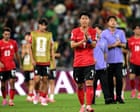
South Korea’s national football team is confronting internal divisions and off-field turmoil in the wake of their 2026 World Cup exit and a parliamentary committee hearing on 21 October that brought squad tensions into the national spotlight. The unrest has followed a summer of resignations, police raids and public criticism of leadership.
Less than 18 months after Son Heung-min captained Tottenham Hotspur to the Europa League — his last act for the club after a decade in the Premier League — he moved to Los Angeles FC in Major League Soccer, a transfer he said was partly to prepare for the 2026 World Cup. That tournament ended in a group-stage exit for South Korea, accompanied by a media boycott after unnamed reporters were said to have mocked Son’s lack of military service, and he started on the bench for the final game, a dismal defeat to South Africa. In the aftermath, coach Hong Myung-bo and KFA president Chung Mong-gyu stepped down, were questioned by parliamentarians and police raided KFA offices.
On 21 October, during a parliamentary committee meeting, politician Jeong Yeon-wook asked acting Korea Football Association president Lee Yong-soo: “It is said that recently, within the national team squad, players have been calling him not by his name but as ‘No 7’ or ‘that person’. Do you know who that is?” Lee replied, “Are you referring to Son Heung-min?” Jeong went on: “So it appears to be true. … It has also been revealed that the national team’s leadership is causing discord and has broken down overall.” Lee declined to comment.
Sources describe a widening split between older and younger players. The article recalls Guus Hiddink addressing similar issues in 2001 by forcing players to sit together so juniors could shout instructions at seniors, and cites an earlier incident at the Asian Cup in 2024 when an altercation over table tennis involving Son and younger players including Lee Kang-in resulted in the captain dislocating a finger; Lee and Son later made up.
Members of the so-called class of 1996 — Kim Min-jae of Bayern Munich, FC Porto’s Hwang In-beom and Hwang Hee-chan, formerly of Wolverhampton Wanderers and now with Schalke 04 — are reported to be unhappy with leadership and sought a fresh start with a new captain and head coach after the World Cup. The federation appointed interim Robert Moreno in September until the end of November, while the KFA currently has no president, and the Asian Cup, a tournament that the Taeguk Warriors have not won since 1960, is described as just weeks away.
Voices within the squad have been public. After a 0-0 draw with Venezuela on 2 October, Hwang In-beom said: “I’m tired physically and mentally. It’s been about nine years since I joined the national team, and from then until now, there are many things that need to change, in football and in many other areas, but it doesn’t seem to be happening.” Kim Min-jae added: “Everyone needs to fight and compete together, but we didn’t do that. Look at our defenders; I felt sorry for them.” As the international window closed there were reports the three were prepared to quit the national team before being persuaded not to by a KFA official, reports the association did not deny.
Son remains popular in Korea despite leaving the country at 16, but his relationship with the domestic media is described as different to that of his teammates, and some fans believe reporters are stirring the story in retaliation for the World Cup media boycott. At 34, Son is described in the piece as no longer an elite-level forward, though he produced moments such as a free-kick against Uzbekistan on 6 October that gave him his 59th international goal; debate continues over his best role in the team and whether he should start.
The article says the 2030 World Cup is unlikely for Son but that helping South Korea win the Asian Cup, which is scheduled to kick off 7 January, would be a fine legacy. It also notes a possibility the tournament could be delayed until 2028 because of Houthi attacks on Saudi Arabia, a postponement that the piece suggests might either give the squad time to reconcile or allow existing divisions to deepen.