Singapore Grand Prix faces 'unhealthy' air as 'super' El Niño fuels wildfire haze

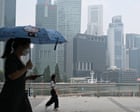
Formula 1 drivers will compete in Singapore under air described as "unhealthy" ahead of Sunday’s Grand Prix after haze from Indonesian wildfires intensified under a "super" El Niño. Medical and scientific sources cited by organisers warn the pollution could affect preparation and cognitive performance.
The haze drifting over the city-state originates from large wildfires in neighbouring Indonesia, with fires worsening this year as a "super" El Niño has exacerbated blazes in parts of Sumatra and Kalimantan. "Rainfall across the region has been about 80% below normal since June, fuelling the most intense fire season in over a decade," said Wang Jingyu, an assistant professor at Singapore’s National Institute of Education at Nanyang Technological University. Singapore’s National Environment Agency classified air quality levels as "unhealthy" on Tuesday. The city’s annual night race, normally used to display its illuminated skyline, will take place under a pall of smoke.
Organisers said the polluted conditions are not expected to cause any disruption to the racing schedule this weekend but contingency arrangements exist if the haze worsens. An FIA spokesperson told the Guardian that "there is a contingency in place" if the haze worsens and there "may be some restrictions on outdoor activity", although that is unlikely to apply to members of the paddock and would instead focus on "entertainment activities". The organisers of the Singapore night race said they will ensure the availability of N95 masks on-site if required and will "work closely with the relevant agencies" to make any decisions regarding the race weekend if the haze causes "visibility, public health or operational issues".
On visibility and operational safety, the FIA said it has "no concerns" about visibility. A Formula One spokesperson added: "There is absolutely no risk to the event and the conditions where the event is taking place are not at any level of concern." Several teams told the Guardian they have made no changes to their plans, while Audi, competing in their first Singapore Grand Prix, said its drivers are trained to cope with a range of conditions, including "varying levels of air quality".
Experts warned of potential effects on driver performance from prolonged exposure. Chris Carlsten, a professor of medicine at the University of British Columbia and an expert in the effects of air pollution on physiology, said prolonged exposure to the haze during the race could affect drivers’ cognitive performance and cited a study in which participants spent two hours in conditions with high levels of air pollution before completing cognitive tests, including assessments of reaction times. "Our findings show that the pollution effect is similar to that of an alcoholic beverage," Carlsten said, and he said he would advise all drivers to wear masks if the air quality remains poor, allowing them to "keep their lungs clean" before the race.
Pre-race routines may also be disrupted: Chris Tyler, a reader in environmental physiology at the University of Roehampton who has worked with F1 drivers including Oscar Piastri and Carlos Sainz, noted drivers often exercise outdoors to acclimatise to the Singapore heat and warned that "these are the sorts of environments where prolonged exposure to the pollution over a number of days could be somewhat detrimental." Lewis Hamilton received similar advice in 2019, when the Singapore Grand Prix was last held in hazy conditions and the seven-time world champion said he had been advised not to go running outside in the days leading up to the race. For the hundreds of thousands of spectators expected to pack the circuit, exposure could last several hours, particularly for those attending concerts and other events around the race.
Wang said short-term exposure to haze will generally cause only mild irritation in healthy people, likely in the form of a "dry or sore throat, coughing or sneezing", but vulnerable groups, including "elderly people, pregnant women and children", face a higher risk, with haze potentially aggravating pre-existing conditions such as "asthma" or triggering "acute bronchitis". Rain could offer some respite, with thundery showers forecast for Singapore on both Friday and Saturday afternoon.
The F1 paddock will arrive in Singapore from Kuala Lumpur following Sunday’s eventful race at Sepang, and organisers and authorities will monitor air quality and operational conditions as the weekend progresses.