South Korea facing possible Premier League absence as Japanese players surge

South Korea could begin the new English Premier League season without a single player for the first time since Park Ji-sung’s 2005 move to Manchester United, while the number of Japanese players in the division is rising ahead of the campaign. The prospect follows a difficult summer for South Korean football that included a poor World Cup showing, corruption allegations and leadership changes.
South Korea’s national team “crashed and burned” at the World Cup, the article says, and the country’s football association is under a police investigation amid reports of bribes paid to foreign referees in 2011 and 2012. The head coach and the FA president have both resigned, and Park Ji-sung has been appointed to head a new "reform football committee" to address the turmoil. Park has talked of the need to follow Japan’s long-term philosophy to close the gap with what is clearly Asia’s best team.
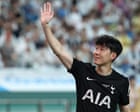
The era that began with Park’s 2005 transfer and continued through Son Heung-min’s decade at Tottenham — where he joined in 2015, became club captain and lifted the Europa League in 2025 — has produced a wide range of Korean exports. The list includes well-remembered figures such as Ki Sung-yueng, Lee Young-pyo and Lee Chung-yong as well as players whose English careers were limited: Cho Won-hee, Yun Suk-young and Park Chu-young barely featured at Wigan, QPR and Arsenal respectively.
There have also been cult moments and misfires: Ji Dong-won scored a last-minute winner against Manchester City for Sunderland, and Lee Dong-gook, despite a long career, failed to score for Middlesbrough. Son’s transfer from London to Los Angeles has left Hwang Hee-chan as the only Korean in the Premier League until his relegation with Wolves; three Koreans remain on Premier League books — Yang Min-hyeok at Spurs, Kim Ji-soo at Brentford and Park Seung-soo at Newcastle — but the article reports they are likely to be loaned out.
Lee Kang-in was linked with a move to England but in July joined Atlético Madrid, taking Antoine Griezmann’s No 7 shirt. The piece notes Lee was introduced to the nation at age six as a child TV reality star and joined Valencia’s academy four years later; it adds that he is "perhaps Asia’s biggest name" and will play in England only in Champions League matches while at Atlético.
Japanese players now feature more prominently across the Premier League. Kaoru Mitoma impressed with Brighton, while Daichi Kamada is at Crystal Palace, joined at Selhurst by Takehiro Tomiyasu; Ao Tanaka plays for Leeds and Wataru Endo is with Liverpool. Recent signings include Hidemasa Morita, signed by Hull after last appearing in England for Sporting Lisbon in the Champions League quarter-final against Arsenal in March, and Daizen Maeda, who became Ipswich’s first Japanese player after a Celtic spell that yielded five league titles.
The article records Japan’s World Cup match against Brazil in which the five-time champions came from behind to win in the 96th minute, and contrasts that with Korea’s tournament results: a 2-1 win against Czechia followed by 1-0 defeats to Mexico and South Africa. AIA’s 2022 report is cited as claiming "there were 12 million fans of the club in the country" in reference to Tottenham, but a Korean television executive is quoted saying viewing figures for Spurs games are nowhere near what they were. The piece notes Premier League interest in Korea has been largely player driven, citing how Son’s presence influenced broadcasts and recalling that during Park’s era Manchester United matches were often the only ones shown.
With Son departed and Hwang’s appearance against Burnley in May likely to be the last Korean outing in England’s top tier for some time, the article concludes that Japanese recruitment and presence in the Premier League is increasing while Korean representation appears set to decline for the imminent season.