Survivors of Melbourne 1956 gather at MCG to mark 70th anniversary and offer advice for Brisbane 2032

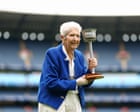
More than 30 of Australia’s 54 surviving 1956 Olympians gathered at the Melbourne Cricket Ground on Sunday to mark the 70th anniversary of the opening ceremony of the Melbourne Games. They spent the day reminiscing and many attended in their original Olympic blazers.
When the Brisbane Olympic Games arrive in 2032 it will be three-quarters of a century since Australia first hosted the world’s biggest sports event in Melbourne in 1956, and several of the former competitors used the anniversary to reflect on that legacy. Age has taken its toll physically, but attendees included triple Olympic swimming gold medallist Dawn Fraser and Olympic medal-winning sprinter Marlene Mathews, both of whom spoke about the past and about what a future home Games should learn from Melbourne.
Fraser, 89 and wheelchair-bound after a fall in 2024, remained a visible supporter of Australian swimming and pointed to Melbourne’s example for future hosts. She is connected to the current team through her goddaughter Lani Pallister, who won the 400m, 800m and 1500m freestyle treble at the Glasgow Commonwealth Games in July and then defeated Katie Ledecky in the 800m at the Pan Pacific Championships in California weeks later. Fraser said: "Melbourne showed us how to welcome the world, and Brisbane can learn from that," and advised younger athletes to "Be excited about it and train hard."
Mathews, 92, spoke about the personal disappointment she still feels from 1956 after being left out of Australia’s gold-medal-winning 4 x 100m relay despite taking bronze in both the individual 100m and 200m behind Betty Cuthbert. "It still hurts," she said, while also recalling her recovery to win the 100m and 200m at the 1958 Commonwealth Games and to set world records over 100 yards, 200m, 400m and 440 yards. She described her competitive drive: "The fact was, I was determined that I wasn’t going to let Betty beat me in a 100 again," and added, "It’s in you, the fact that you want to run, you want to run fast."
On the current state of sprinting, Mathews welcomed recent results and named several young athletes by achievement, citing Commonwealth silver medallist Lachlan Kennedy, bronze medallist Torrie Lewis and world junior record-holder Gout Gout. "Isn’t it wonderful?" she asked, later saying: "We’ve got men and women doing well. I don’t see any reason why we haven’t done well [before] because we’ve got good coaches, but no, it’s coming good." Her practical counsel to today’s competitors was to treat the Olympics as "just another race, without having to do anything special."
Australian Olympic Committee president Ian Chesterman framed the 1956 Games as foundational for Australia’s reputation as a host nation, noting that legacy can be seen in Melbourne itself and in the subsequent awarding of the 2000 Olympics to Sydney and the 2032 Games to Brisbane. "Melbourne became an Olympic city, and that became integrated into so many different parts of society," he said. "So I think if Brisbane can walk away at the end with the pride, the confidence, the memories, and the capabilities that come from being a host city, which Melbourne did – albeit in a very different time – then that’s an incredible outcome. [Melbourne] set up Australia to host in Sydney and Brisbane. I always say that the rest of us stand on the shoulders of the Olympic team at ‘56 in the Melbourne Games. That’s the reality… It’s because of that reputation, which all started here."
The 309-member Melbourne team won 35 medals, including 13 gold, and swept the freestyle events in the pool, finishing third on the 1956 medal tally and remaining Australia’s most successful Olympic team until Sydney. Fraser and Mathews expressed the hope that Australia can replicate that level of success at a future home Games; Mathews said, "I just hope I’m still alive to be able to go in 2032," adding, "I’ll be nearly 100."