VAR, timewasting and subs: new laws introduced for 2026-27 English season

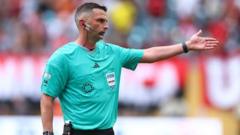
English football will introduce a package of law changes on VAR, timewasting and substitutions for the 2026-27 season, to be implemented from Sunday's Community Shield between Arsenal and Manchester City. Many of the measures were trialled at the World Cup and will apply across the professional game down to grassroots levels, though VAR interventions will be narrower than at the World Cup.
The season will see an unprecedented number of new laws aimed at reducing deliberate delays and increasing playing time. Michael Oliver is the Premier League's number one following Anthony Taylor's retirement. The changes, first used at the World Cup, produced higher ball-in-play percentages: Qatar 2022 averaged 58 minutes three seconds (56.86% of total match time) while this summer averaged 58 minutes 16 seconds and 60.43% of match time with far less added time. Confusion over the new procedures surfaced in the opening round of the Carabao Cup.
Restart delays will be policed with a visible five-second countdown: the referee will blow the whistle to prompt a player, signal the start of the count with an arm movement and blow again if the player fails to restart in time, awarding the throw-in to the opposing team. The countdown can be triggered by any action deemed to disrupt play, including leaving the ball on a cone or dropping it for a team-mate, but long throws are exempt as set-piece routines. Goalkeepers who take excessive time over goal-kicks late in matches can be penalised by the referee awarding a corner to the opposition.
Substituted players will have 10 seconds to leave the field at the nearest point; failure to do so means the named substitute cannot enter for at least one minute and the team must play with 10 players until the next stoppage. Middlesbrough's Will Lankshear was the first player sanctioned under the rule during the Carabao Cup tie against Wrexham after his 80th-minute goal; with Boro leading 1-0 he jogged off the pitch while clapping supporters and substitute Fin Cartwright was told he could not come on immediately. Will Lankshear, the former Tottenham player, said after the game: "I didn't know!"
Injury treatment protocols have been tightened: players now must go off for up to one minute if the referee stops play for treatment, even if they did not request it, to prevent breaks that disrupt the opposition's momentum; the rule does not apply when the ball naturally goes out of play for a throw-in or goal-kick. There are exemptions, including genuine injury or security concerns, and if the player who committed the foul receives a yellow or red card the injured player does not have to stay off in all circumstances.
A new trial targeting the goalkeeper tactical timeout will be adopted across English professional competitions: if a goalkeeper requests treatment an outfield player selected by the coach must leave the field for one minute, with a 10-second deadline to notify the fourth official of who will come off or the captain must provide the information. Other countries are experimenting with a variant requiring the keeper's captain to leave, and the English trial includes similar exemptions for fouls or bleeding to the goalkeeper.
The laws clarify goal-kick situations: when the ball is kicked by the goalkeeper or a defender the goal-kick will be treated as taken, and any handball by a defender after such a kick will be a penalty or an indirect free-kick for a backpass if it involves the goalkeeper. The guidance follows incidents cited in the article, including Aston Villa's Tyrone Mings conceding a penalty against Club Brugge in November 2024 after Emiliano Martinez kicked the ball to him, and Gabriel not being penalised when touching the ball against Bayern Munich after David Raya kicked it to him.
VAR will have a narrower remit than at the World Cup but a few additional review areas: it can check a second yellow that leads to a red card if there is a clear error, but cannot review potential second bookings for players already on a yellow. As part of a trial, VAR may review an attacking foul before the ball is in play if that foul directly leads to a goal, penalty or disciplinary sanction, with the restart being a retake of the corner; it will not review defensive fouls before the ball is in play. The laws board has clarified mistaken identity should be corrected only when the referee has penalised Team A for an incident actually committed by Team B, and VAR will not intervene on incorrect corners or on red cards for players covering their mouths in confrontations.
The new procedures will be used beginning at Sunday's Community Shield between Arsenal and Manchester City and will extend through the Premier League and down to Sunday-league football, with the stated aim of reducing timewasting and increasing the amount of active play.